19 real exam questions with step-by-step video solutions · Try each question yourself first, then open the video solution to check your working. Stuck? Ask Axi below – it knows this page’s questions.
New · Axi
Stuck on an arithmetic series question?
Axi, our AI tutor, answers questions on any arithmetic sequence or series problem on this page – no copying, no pasting, no sign-up.
What are you stuck on? Ask about any arithmetic sequence or series question on this page and I will talk you through it.
Axi answers from this page’s question, tutorial and worked solution. Live Axi reads and marks your own working in the app.
1EDEXCEL C1 June 2014 Q8
In the year 2000 a shop sold 150 computers. Each year the shop sold 10 more computers than the year before, so that the shop sold 160 computers in 2001, 170 computers in 2002, and so on forming an arithmetic sequence. (a) Show that the shop sold 220 computers in 2007. (2) (b) Calculate the total number of computers the shop sold from 2000 to 2013 inclusive. (3) In the year 2000, the selling price of each computer was 900 pounds. The selling price fell by 20 pounds each year, so that in 2001 the selling price was 880 pounds, in 2002 the selling price was 860 pounds, and so on forming an arithmetic sequence. (c) In a particular year, the selling price of each computer in pounds was equal to three times the number of computers the shop sold in that year. By forming and solving an equation, find the year in which this occurred. (4)
View video solution (3 parts)
Part (a):
Part (b):
Part (c):
2CIE P1 November 2013 Q9
(a) In an arithmetic progression the sum of the first ten terms is 400 and the sum of the next ten terms is 1000. Find the common difference and the first term. (5) (b) A geometric progression has first term a, common ratio r and sum to infinity 6. A second geometric progression has first term 2a, common ratio r^2 and sum to infinity 7. Find the values of a and r. (5)
View video solution (2 parts)
Part (a):
Part (b):
3OCR C2 June 2013 Q6
Sarah is carrying out a series of experiments which involve using increasing amounts of a chemical. In the first experiment she uses 6 g of the chemical and in the second experiment she uses 7.8 g of the chemical. (i) Given that the amounts of the chemical used form an arithmetic progression, find the total amount of chemical used in the first 30 experiments. (3) (ii) Instead it is given that the amounts of the chemical used form a geometric progression. Sarah has a total of 1800 g of the chemical available. Show that N, the greatest number of experiments possible, satisfies the inequality 1.3^N <= 91, and use logarithms to calculate the value of N. (6)
View video solution (2 parts)
Part (a):
Part (b):
4EDEXCEL C1 June 2013 Q7
A company, which is making 200 mobile phones each week, plans to increase its production. The number of mobile phones produced is to be increased by 20 each week from 200 in week 1 to 220 in week 2, to 240 in week 3 and so on, until it is producing 600 in week N. (a) Find the value of N. (2) The company then plans to continue to make 600 mobile phones each week. (b) Find the total number of mobile phones that will be made in the first 52 weeks starting from and including week 1. (5)
View video solution (1 part)
Part (a):
5EDEXCEL C1 January 2013 Q7
Lewis played a game of space invaders. He scored points for each spaceship that he captured. Lewis scored 140 points for capturing his first spaceship. He scored 160 points for capturing his second spaceship, 180 points for capturing his third spaceship, and so on. The number of points scored for capturing each successive spaceship formed an arithmetic sequence. (a) Find the number of points that Lewis scored for capturing his 20th spaceship. (2) (b) Find the total number of points Lewis scored for capturing his first 20 spaceships. (3) Sian played an adventure game. She scored points for each dragon that she captured. The number of points that Sian scored for capturing each successive dragon formed an arithmetic sequence. Sian captured n dragons and the total number of points that she scored for capturing all n dragons was 8500. Given that Sian scored 300 points for capturing her first dragon and then 700 points for capturing her nth dragon, (c) find the value of n. (3)
View video solution (2 parts)
Part (a):
Part (b):
6OCR C2 January 2013 Q6
(i) The first three terms of an arithmetic progression are 2x, x + 4 and 2x - 7 respectively. Find the value of x. (3) (ii) The first three terms of another sequence are also 2x, x + 4 and 2x - 7 respectively. (a) Verify that when x = 8 the terms form a geometric progression and find the sum to infinity in this case. (4) (b) Find the other possible value of x that also gives a geometric progression. (4)
View video solution (2 parts)
Part (a):
Part (b):
7OCR C2 January 2013 Q2
A sequence u1, u2, u3, ... is defined by u1 = 7 and u_{n+1} = u_n + 4 for n >= 1. (i) Show that u17 = 71. (2) (ii) Show that sum_{n=1}^{35} u_n = sum_{n=36}^{50} u_n. (4)
View video solution (1 part)
Part (a):
8OCR C2 June 2012 Q5
(a) A sequence u1, u2, u3, ... is defined by u1 = 4 and u_{n+1} = 2/u_n for n >= 1. (i) Write down the values of u2 and u3. (2) (ii) Describe the behaviour of the sequence. (1) (b) In an arithmetic progression the ninth term is 18 and the sum of the first nine terms is 72. Find the first term and the common difference. (5)
View video solution (2 parts)
Part (a):
Part (b):
9OCR C2 June 2012 Q9
(a) An arithmetic progression has first term log_2 27 and common difference log_2 x. (i) Show that the fourth term can be written as log_2(27x^3). (3) (ii) Given that the fourth term is 6, find the exact value of x. (2) (b) A geometric progression has first term log_2 27 and common ratio log_2 y. (i) Find the set of values of y for which the geometric progression has a sum to infinity. (2) (ii) Find the exact value of y for which the sum to infinity of the geometric progression is 3. (5)
View video solution (2 parts)
Part (a):
Part (b):
10EDEXCEL C1 June 2011 Q9
(a) Calculate the sum of all the even numbers from 2 to 100 inclusive, 2 + 4 + 6 + ...... + 100. (3) (b) In the arithmetic series k + 2k + 3k + ...... + 100, k is a positive integer and k is a factor of 100. (i) Find, in terms of k, an expression for the number of terms in this series. (ii) Show that the sum of this series is 50 + 5000/k. (4) (c) Find, in terms of k, the 50th term of the arithmetic sequence (2k + 1), (4k + 4), (6k + 7), ......, giving your answer in its simplest form. (2)
View video solution (3 parts)
Part (a):
Part (b):
Part (c):
11EDEXCEL C1 January 2011 Q6
Question image is broken on examsolutions.net (dead upload, reported). The video solution below walks through the question.
View video solution (1 part)
Part (a):
12EDEXCEL C1 June 2010 Q9
Question image is broken on examsolutions.net (dead upload, reported). The video solution below walks through the question.
View video solution (3 parts)
Part (a):
Part (b):
Part (c):
13EDEXCEL C1 January 2010 Q7
Jill gave money to a charity over a 20-year period, from Year 1 to Year 20 inclusive. She gave 150 pounds in Year 1, 160 pounds in Year 2, 170 pounds in Year 3, and so on, so that the amounts of money she gave each year formed an arithmetic sequence. (a) Find the amount of money she gave in Year 10. (2) (b) Calculate the total amount of money she gave over the 20-year period. (3) Kevin also gave money to the charity over the same 20-year period. He gave A pounds in Year 1 and the amounts of money he gave each year increased, forming an arithmetic sequence with common difference 30 pounds. The total amount of money that Kevin gave over the 20-year period was twice the total amount of money that Jill gave. (c) Calculate the value of A. (4)
View video solution (1 part)
Part (a):
14EDEXCEL C1 June 2009 Q5
A 40-year building programme for new houses began in Oldtown in the year 1951 (Year 1) and finished in 1990 (Year 40). The numbers of houses built each year form an arithmetic sequence with first term a and common difference d. Given that 2400 new houses were built in 1960 and 600 new houses were built in 1990, find (a) the value of d, (3) (b) the value of a, (2) (c) the total number of houses built in Oldtown over the 40-year period. (3)
View video solution (3 parts)
Part (a):
Part (b):
Part (c):
15EDEXCEL C1 January 2009 Q9
Question image is broken on examsolutions.net (dead upload, reported). The video solution below walks through the question.
View video solution (4 parts)
Part (a):
Part (b):
Part (c):
Part (d):
16Edexcel A Level June 2022 Paper 1 Q13
(i) In an arithmetic series, the first term is a and the common difference is d. Show that S_n = (n/2)[2a + (n - 1)d]. (3) (ii) James saves money over a number of weeks to buy a printer that costs 64 pounds. He saves 10 pounds in week 1, 9.20 pounds in week 2, 8.40 pounds in week 3 and so on, so that the weekly amounts he saves form an arithmetic sequence. Given that James takes n weeks to save exactly 64 pounds, (a) show that n^2 - 26n + 160 = 0, (2) (b) solve the equation n^2 - 26n + 160 = 0, (1) (c) hence state the number of weeks James takes to save enough money to buy the printer, giving a brief reason for your answer. (1)
View video solution (1 part)
Part (a):
17EDEXCEL C1 January 2008 Q11
The first term of an arithmetic sequence is 30 and the common difference is -1.5. (a) Find the value of the 25th term. (2) The rth term of the sequence is 0. (b) Find the value of r. (2) The sum of the first n terms of the sequence is S_n. (c) Find the largest positive value of S_n. (3)
View video solution (3 parts)
Part (a):
Part (b):
Part (c):
18Edexcel A Level June 2023 Paper 2 Q8
(a) Express 2cos(theta) + 8sin(theta) in the form Rcos(theta - alpha), where R and alpha are constants, R > 0 and 0 < alpha < pi/2. Give the exact value of R and give the value of alpha in radians to 3 decimal places. (3) The first three terms of an arithmetic sequence are cos x, cos x + sin x, cos x + 2sin x, where x is not equal to n*pi. Given that S_9 represents the sum of the first 9 terms of this sequence as x varies, (b)(i) find the exact maximum value of S_9, (ii) deduce the smallest positive value of x at which this maximum value of S_9 occurs. (3)
19Edexcel A Level June 2024 Paper 2 Q2
Jamie takes out an interest-free loan of 8100 pounds. Jamie makes a payment every month to pay back the loan. Jamie repays 400 pounds in month 1, 390 pounds in month 2, 380 pounds in month 3, and so on, so that the amounts repaid each month form an arithmetic sequence. (a) Show that Jamie repays 290 pounds in month 12. (1) After Jamie's Nth payment, the loan is completely paid back. (b) Show that N^2 - 81N + 1620 = 0. (2) (c) Hence find the value of N. (2)
View video solution (1 part)
Part (a):
20Edexcel A Level June 2025 Paper 1 Q3
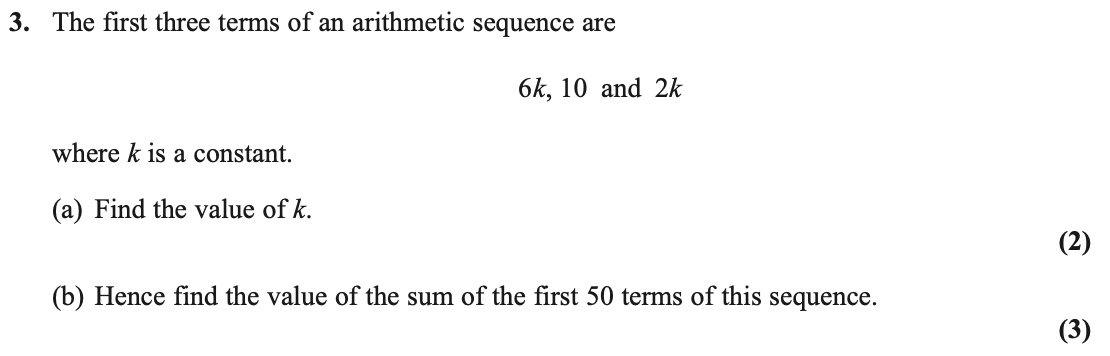
The first three terms of an arithmetic sequence are 6k, 10 and 2k where k is a constant. (a) Find the value of k. (2) (b) Hence find the value of the sum of the first 50 terms of this sequence. (3)