12 real exam questions with step-by-step video solutions · Try each question yourself first, then open the video solution to check your working. Stuck? Ask Axi below – it knows this page’s questions.
New · Axi
Stuck on a factor theorem question?
Axi, our AI tutor, answers questions on any factor theorem problem on this page – no copying, no pasting. Free account, no card.
What are you stuck on? Ask about any factor theorem question on this page and I will talk you through it.
Axi answers from this page’s question, tutorial and worked solution. Live Axi reads and marks your own working in the app.
1Edexcel A Level Specimen Paper 2 Q1
f(x) = 2x^3 - 5x^2 + ax + a. Given that (x + 2) is a factor of f(x), find the value of the constant a. (3)
View video solution (1 part)
Part (a):
2OCR C2 June 2013 Q9
The cubic polynomial f(x) is defined by f(x) = 4x^3 - 7x - 3. (i) Find the remainder when f(x) is divided by (x - 2). [2] (ii) Show that (2x + 1) is a factor of f(x) and hence factorise f(x) completely. [6] (iii) Solve the equation 4cos^3(theta) - 7cos(theta) - 3 = 0 for 0 <= theta <= 2pi. Give each solution for theta in an exact form. [4]
View video solution (3 parts)
Part (a):
Part (b):
Part (c):
3OCR C2 January 2013 Q9
The positive constant a is such that the integral from a to 2a of (2x^3 - 5x^2 + 4)/x^2 dx = 0. (i) Show that 3a^3 - 5a^2 + 2 = 0. [6] (ii) Show that a = 1 is a root of 3a^3 - 5a^2 + 2 = 0, and hence find the other possible value of a, giving your answer in simplified surd form. [6]
View video solution (2 parts)
Part (a):
Part (b):
4EDEXCEL C2 June 2012 Q4
f(x) = 2x^3 - 7x^2 - 10x + 24. (a) Use the factor theorem to show that (x + 2) is a factor of f(x). (2) (b) Factorise f(x) completely. (4)
View video solution (1 part)
Part (a):
5OCR C2 June 2012 Q8
Two cubic polynomials are defined by f(x) = x^3 + (a - 3)x + 2b and g(x) = 3x^3 + x^2 + 5ax + 4b, where a and b are constants. (i) Given that f(x) and g(x) have a common factor of (x - 2), show that a = -4 and find the value of b. [6] (ii) Using these values of a and b, factorise f(x) fully. Hence show that f(x) and g(x) have two common factors. [5]
View video solution (2 parts)
Part (a):
Part (b):
6EDEXCEL C2 June 2011 Q1
f(x) = 2x^3 - 7x^2 - 5x + 4. (a) Find the remainder when f(x) is divided by (x - 1). (2) (b) Use the factor theorem to show that (x + 1) is a factor of f(x). (2) (c) Factorise f(x) completely. (4)
View video solution (3 parts)
Part (a):
Part (b):
Part (c):
7EDEXCEL C2 June 2008 Q1
f(x) = 2x^3 - 3x^2 - 39x + 20. (a) Use the factor theorem to show that (x + 4) is a factor of f(x). (2) (b) Factorise f(x) completely. (4)
View video solution (2 parts)
Part (a):
Part (b):
8EDEXCEL C2 June 2007 Q2
f(x) = 3x^3 - 5x^2 - 16x + 12. (a) Find the remainder when f(x) is divided by (x - 2). (2) Given that (x + 2) is a factor of f(x), (b) factorise f(x) completely. (4)
View video solution (2 parts)
Part (a):
Part (b):
9EDEXCEL C2 January 2007 Q5
f(x) = x^3 + 4x^2 + x - 6. (a) Use the factor theorem to show that (x + 2) is a factor of f(x). (2) (b) Factorise f(x) completely. (4) (c) Write down all the solutions to the equation x^3 + 4x^2 + x - 6 = 0. (1)
View video solution (3 parts)
Part (a):
Part (b):
Part (c):
10Edexcel A Level June 2022 Paper 1 Q2
f(x) = (x - 4)(x^2 - 3x + k) - 42, where k is a constant. Given that (x + 2) is a factor of f(x), find the value of k. (3)
View video solution (1 part)
Part (a):
11Edexcel A Level June 2023 Paper 1 Q2
In this question you must show all stages of your working. Solutions relying entirely on calculator technology are not acceptable. f(x) = 4x^3 + 5x^2 - 10x + 4a, x in R, where a is a positive constant. Given (x - a) is a factor of f(x), (a) show that a(4a^2 + 5a - 6) = 0. (2) (b) Hence (i) find the value of a, (ii) use algebra to find the exact solutions of the equation f(x) = 3. (4)
12Edexcel A Level June 2024 Paper 1 Q1
g(x) = 3x^3 - 20x^2 + (k + 17)x + k, where k is a constant. Given that (x - 3) is a factor of g(x), find the value of k. (3)
View video solution (1 part)
Part (a):
13Edexcel A Level June 2025 Paper 1 Q4
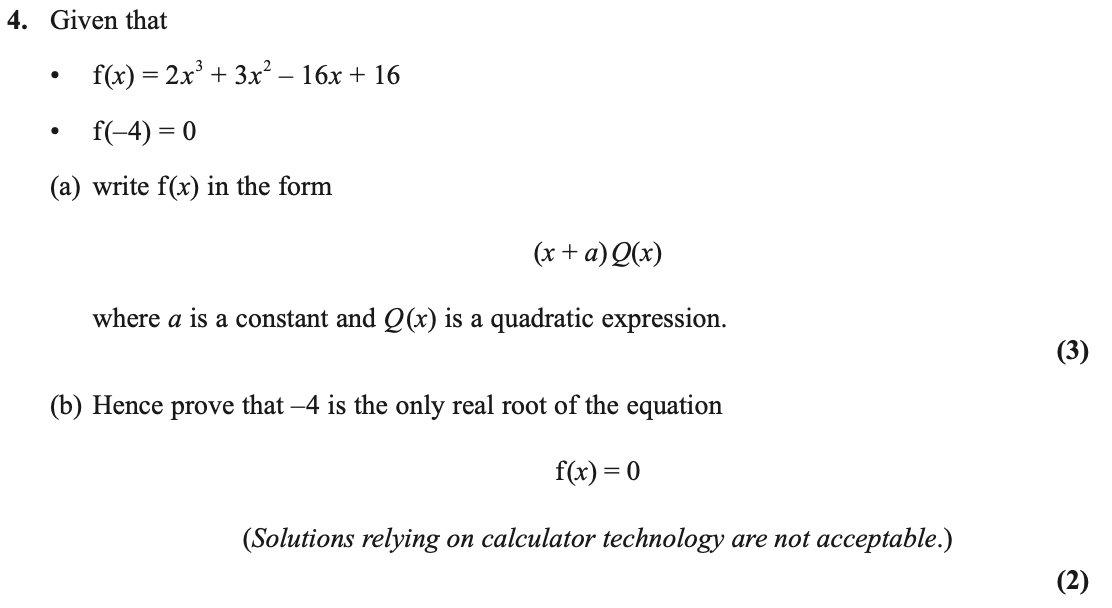
Given that f(x) = 2x^3 + 3x^2 - 16x + 16 and f(-4) = 0, (a) write f(x) in the form (x + a)Q(x) where a is a constant and Q(x) is a quadratic expression. (3) (b) Hence prove that -4 is the only real root of the equation f(x) = 0. Solutions relying on calculator technology are not acceptable. (2)