20 real exam questions with step-by-step video solutions · Try each question yourself first, then open the video solution to check your working. Stuck? Ask Axi below – it knows this page’s questions.
New · Axi
Stuck on forming a differential equation?
Axi, our AI tutor, answers questions on any differential equation problem on this page – no copying, no pasting, no sign-up.
What are you stuck on? Ask about any differential equation question on this page and I will talk you through it.
Axi answers from this page’s question, tutorial and worked solution. Live Axi reads and marks your own working in the app.
1Edexcel A Level June 2018 Paper 2 Q10
A spherical mint of radius 5 mm is placed in the mouth and sucked. Four minutes later, the radius of the mint is 3 mm. In a simple model, the rate of decrease of the radius of the mint is inversely proportional to the square of the radius. Using this model and all the information given, (a) find an equation linking the radius of the mint and the time. (You should define the variables that you use.) (5) (b) Hence find the total time taken for the mint to completely dissolve. Give your answer in minutes and seconds to the nearest second. (2) (c) Suggest a limitation of the model. (1)
View video solution (3 parts)
Part (a):
Part (b):
Part (c):
2OCR C4 June 2013 Q8
At time t seconds, the radius of a spherical balloon is r cm. The balloon is being inflated so that the rate of increase of its radius is inversely proportional to the square root of its radius. When t = 5, r = 9 and, at this instant, the radius is increasing at 1.08 cm s^(-1). (i) Write down a differential equation to model this situation, and solve it to express r in terms of t. [7] (ii) How much air is in the balloon initially? [2] [The volume of a sphere is V = (4/3) pi r^3.]
View video solution (2 parts)
Part (a):
Part (b):
3EDEXCEL C4 June 2013 Q6
Water is being heated in a kettle. At time t seconds, the temperature of the water is theta degC. The rate of increase of the temperature of the water at any time t is modelled by the differential equation d(theta)/dt = lambda(120 - theta), theta <= 100, where lambda is a positive constant. Given that theta = 20 when t = 0, (a) solve this differential equation to show that theta = 120 - 100 e^(-lambda t). (8) When the temperature of the water reaches 100 degC, the kettle switches off. (b) Given that lambda = 0.01, find the time, to the nearest second, when the kettle switches off. (3)
View video solution (2 parts)
Part (a):
Part (b):
4EDEXCEL C4 January 2013 Q8
A bottle of water is put into a refrigerator. The temperature inside the refrigerator remains constant at 3 degC and t minutes after the bottle is placed in the refrigerator the temperature of the water in the bottle is theta degC. The rate of change of the temperature of the water in the bottle is modelled by the differential equation d(theta)/dt = (3 - theta)/125. (a) By solving the differential equation, show that theta = A e^(-0.008t) + 3, where A is a constant. (4) Given that the temperature of the water in the bottle when it was put in the refrigerator was 16 degC, (b) find the time taken for the temperature of the water in the bottle to fall to 10 degC, giving your answer to the nearest minute. (5)
View video solution (2 parts)
Part (a):
Part (b):
5EDEXCEL C4 June 2012 Q4
Given that y = 2 at x = pi/4, solve the differential equation dy/dx = 3/(y cos^2 x). (5)
View video solution (1 part)
Part (a):
6EDEXCEL C4 January 2012 Q8
(a) Express 1/(P(5 - P)) in partial fractions. (3) A team of conservationists is studying the population of meerkats on a nature reserve. The population is modelled by the differential equation dP/dt = (1/15) P(5 - P), t >= 0, where P, in thousands, is the population of meerkats and t is the time measured in years since the study began. Given that when t = 0, P = 1, (b) solve the differential equation, giving your answer in the form P = a/(b + c e^(-t/3)), where a, b and c are integers. (8) (c) Hence show that the population cannot exceed 5000. (1)
View video solution (3 parts)
Part (a):
Part (b):
Part (c):
7EDEXCEL C4 June 2011 Q8
(a) Find the integral of (4y + 3)^(-1/2) dy. (2) (b) Given that y = 1.5 at x = -2, solve the differential equation dy/dx = sqrt(4y + 3)/x^2, giving your answer in the form y = f(x). (6)
View video solution (2 parts)
Part (a):
Part (b):
8EDEXCEL C4 January 2011 Q3
(a) Express 5/((x - 1)(3x + 2)) in partial fractions. (3) (b) Hence find the integral of 5/((x - 1)(3x + 2)) dx, where x > 1. (3) (c) Find the particular solution of the differential equation (x - 1)(3x + 2) dy/dx = 5y, x > 1, for which y = 8 at x = 2. Give your answer in the form y = f(x). (6)
View video solution (3 parts)
Part (a):
Part (b):
Part (c):
9EDEXCEL C4 June 2010 Q8
Figure 2 shows a cylindrical water tank. The diameter of a circular cross-section of the tank is 6 m. Water is flowing into the tank at a constant rate of 0.48 pi m^3 min^(-1). At time t minutes, the depth of the water in the tank is h metres. There is a tap at a point T at the bottom of the tank. When the tap is open, water leaves the tank at a rate of 0.6 pi h m^3 min^(-1). (a) Show that t minutes after the tap has been opened 75 dh/dt = (4 - 5h). (5) When t = 0, h = 0.2. (b) Find the value of t when h = 0.5. (6)
View video solution (2 parts)
Part (a):
Part (b):
10EDEXCEL C4 January 2010 Q5
(a) Find the integral of (9x + 6)/x dx, x > 0. (2) (b) Given that y = 8 at x = 1, solve the differential equation dy/dx = ((9x + 6) y^(1/3))/x, giving your answer in the form y^2 = g(x). (6)
View video solution (2 parts)
Part (a):
Part (b):
11EDEXCEL C4 June 2008 Q7
(a) Express 2/(4 - y^2) in partial fractions. (3) (b) Hence obtain the solution of 2 cot x dy/dx = (4 - y^2), for which y = 0 at x = pi/3, giving your answer in the form sec^2 x = g(y). (8)
View video solution (2 parts)
Part (a):
Part (b):
12EDEXCEL C4 January 2008 Q8
Liquid is pouring into a large vertical circular cylinder at a constant rate of 1600 cm^3 s^(-1) and is leaking out of a hole in the base, at a rate proportional to the square root of the height of the liquid already in the cylinder. The area of the circular cross section of the cylinder is 4000 cm^2. (a) Show that at time t seconds, the height h cm of liquid in the cylinder satisfies the differential equation dh/dt = 0.4 - k sqrt(h), where k is a positive constant. (3) When h = 25, water is leaking out of the hole at 400 cm^3 s^(-1). (b) Show that k = 0.02. (1) (c) Separate the variables of the differential equation dh/dt = 0.4 - 0.02 sqrt(h), to show that the time taken to fill the cylinder from empty to a height of 100 cm is given by the integral from 0 to 100 of 50/(20 - sqrt(h)) dh. (2) Using the substitution h = (20 - x)^2, or otherwise, (d) find the exact value of the integral from 0 to 100 of 50/(20 - sqrt(h)) dh. (6) (e) Hence find the time taken to fill the cylinder from empty to a height of 100 cm, giving your answer in minutes and seconds to the nearest second. (1)
View video solution (5 parts)
Part (a):
Part (b):
Part (c):
Part (d):
Part (e):
13EDEXCEL C4 June 2007 Q8
A population growth is modelled by the differential equation dP/dt = kP, where P is the population, t is the time measured in days and k is a positive constant. Given that the initial population is P0, (a) solve the differential equation, giving P in terms of P0, k and t. (4) Given also that k = 2.5, (b) find the time taken, to the nearest minute, for the population to reach 2P0. (3) In an improved model the differential equation is given as dP/dt = lambda P cos(lambda t), where P is the population, t is the time measured in days and lambda is a positive constant. Given, again, that the initial population is P0 and that time is measured in days, (c) solve the second differential equation, giving P in terms of P0, lambda and t. (4) Given also that lambda = 2.5, (d) find the time taken, to the nearest minute, for the population to reach 2P0 for the first time, using the improved model. (3)
View video solution (4 parts)
Part (a):
Part (b):
Part (c):
Part (d):
14EDEXCEL C4 January 2007 Q4
(a) Express (2x - 1)/((x - 1)(2x - 3)) in partial fractions. (3) (b) Given that x >= 2, find the general solution of the differential equation (2x - 3)(x - 1) dy/dx = (2x - 1) y. (5) (c) Hence find the particular solution of this differential equation that satisfies y = 10 at x = 2, giving your answer in the form y = f(x). (4)
View video solution (3 parts)
Part (a):
Part (b):
Part (c):
15EDEXCEL C4 June 2006 Q7
At time t seconds the length of the side of a cube is x cm, the surface area of the cube is S cm^2, and the volume of the cube is V cm^3. The surface area of the cube is increasing at a constant rate of 8 cm^2 s^(-1). Show that (a) dx/dt = k/x, where k is a constant to be found, (4) (b) dV/dt = 2V^(1/3). (4) Given that V = 8 when t = 0, (c) solve the differential equation in part (b), and find the value of t when V = 16 sqrt(2). (7)
View video solution (2 parts)
Part (a):
Part (b):
16Edexcel A Level June 2022 Paper 2 Q14
(a) Express 3/((2x - 1)(x + 1)) in partial fractions. (3) When chemical A and chemical B are mixed, oxygen is produced. A scientist mixed these two chemicals and measured the total volume of oxygen produced over a period of time. The total volume of oxygen produced, V m^3, t hours after the chemicals were mixed, is modelled by the differential equation dV/dt = 3V/((2t - 1)(t + 1)), V >= 0, t >= k, where k is a constant. Given that exactly 2 hours after the chemicals were mixed, a total volume of 3 m^3 of oxygen had been produced, (b) solve the differential equation to show that V = 3(2t - 1)/(t + 1). (5) The scientist noticed that there was a time delay between the chemicals being mixed and oxygen being produced, and there was a limit to the total volume of oxygen produced. Deduce from the model (c) (i) the time delay giving your answer in minutes, (ii) the limit giving your answer in m^3. (2)
View video solution (1 part)
Part (a):
17Edexcel A Level June 2019 Paper 2 Q14
(a) Use the substitution u = 4 - sqrt(h) to show that the integral of dh/(4 - sqrt(h)) = -8 ln|4 - sqrt(h)| - 2 sqrt(h) + k, where k is a constant. (6) A team of scientists is studying a species of slow growing tree. The rate of change in height of a tree in this species is modelled by the differential equation dh/dt = (t^0.25 (4 - sqrt(h)))/20, where h is the height in metres and t is the time, measured in years, after the tree is planted. (b) Find, according to the model, the range in heights of trees in this species. (2) One of these trees is one metre high when it is first planted. According to the model, (c) calculate the time this tree would take to reach a height of 12 metres, giving your answer to 3 significant figures. (7)
View video solution (1 part)
Part (a):
18Edexcel A Level June 2023 Paper 2 Q11
A tank in the shape of a cuboid is being filled with water. The base of the tank measures 20 m by 10 m and the height of the tank is 5 m, as shown in Figure 1. At time t minutes after water started flowing into the tank the height of the water was h m and the volume of water in the tank was V m^3. In a model of this situation, the sides of the tank have negligible thickness and the rate of change of V is inversely proportional to the square root of h. (a) Show that dh/dt = lambda/sqrt(h), where lambda is a constant. (3) Given that initially the height of the water in the tank was 1.44 m and exactly 8 minutes after water started flowing into the tank the height of the water was 3.24 m, (b) use the model to find an equation linking h with t, giving your answer in the form h^(3/2) = At + B, where A and B are constants to be found. (5) (c) Hence find the time taken, from when water started flowing into the tank, for the tank to be completely full. (2)
19Edexcel A Level June 2024 Paper 1 Q7
Figure 2 shows a cylindrical tank of height 1.5 m. Initially the tank is full of water. The water starts to leak from a small hole, at a point L, in the side of the tank. While the tank is leaking, the depth, H metres, of the water in the tank is modelled by the differential equation dH/dt = -0.12 e^(-0.2t), where t hours is the time after the leak starts. Using the model, (a) show that H = A e^(-0.2t) + B, where A and B are constants to be found, (3) (b) find the time taken for the depth of the water to decrease to 1.2 m. Give your answer in hours and minutes, to the nearest minute. (3) In the long term, the water level in the tank falls to the same height as the hole. (c) Find, according to the model, the height of the hole from the bottom of the tank. (2)
View video solution (1 part)
Part (a):
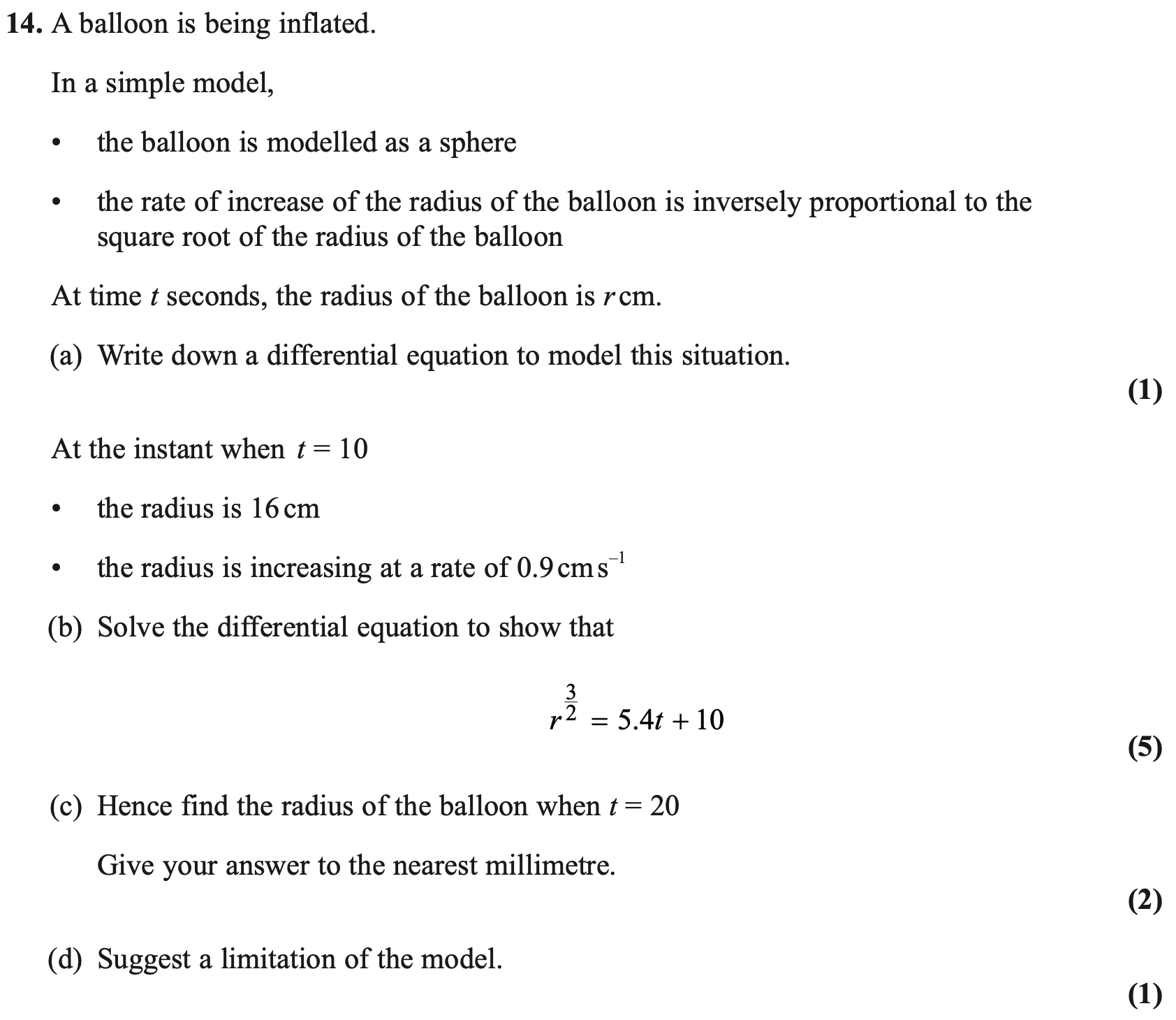
20Edexcel A Level June 2024 Paper 1 Q14
A balloon is being inflated. In a simple model, the balloon is modelled as a sphere and the rate of increase of the radius of the balloon is inversely proportional to the square root of the radius of the balloon. At time t seconds, the radius of the balloon is r cm. (a) Write down a differential equation to model this situation. (1) At the instant when t = 10, the radius is 16 cm and the radius is increasing at a rate of 0.9 cm s^(-1). (b) Solve the differential equation to show that r^(3/2) = 5.4t + 10. (5) (c) Hence find the radius of the balloon when t = 20. Give your answer to the nearest millimetre. (2) (d) Suggest a limitation of the model. (1)