16 real exam questions with step-by-step video solutions · Try each question yourself first, then open the video solution to check your working. Stuck? Ask Axi below – it knows this page’s questions.
New · Axi
Stuck on a harmonic identity question?
Axi, our AI tutor, answers questions on any harmonic form problem on this page – no copying, no pasting. Free account, no card.
What are you stuck on? Ask about any harmonic identity question on this page and I will talk you through it.
Axi answers from this page’s question, tutorial and worked solution. Live Axi reads and marks your own working in the app.
1Edexcel A Level Specimen Paper 2 Q13
(a) Express 10cos(theta) - 3sin(theta) in the form Rcos(theta + alpha), where R > 0 and 0 < alpha < 90deg. Give the exact value of R and give the value of alpha, in degrees, to 2 decimal places. (3) The height above the ground, H metres, of a passenger on a Ferris wheel t minutes after the wheel starts turning, is modelled by the equation H = a - 10cos(80t)deg + 3sin(80t)deg, where a is a constant. Figure 3 shows the graph of H against t for two complete cycles of the wheel. Given that the initial height of the passenger above the ground is 1 metre, (b) (i) find a complete equation for the model, (ii) hence find the maximum height of the passenger above the ground. (2) (c) Find the time taken, to the nearest second, for the passenger to reach the maximum height on the second cycle. (Solutions based entirely on graphical or numerical methods are not acceptable.) (3) It is decided that, to increase profits, the speed of the wheel is to be increased. (d) How would you adapt the equation of the model to reflect this increase in speed? (1)
View video solution (4 parts)
Part (a):
Part (b):
Part (c):
Part (d):
2EDEXCEL C3 June 2014 Q9
(a) Express 2sin(theta) - 4cos(theta) in the form Rsin(theta - alpha), where R and alpha are constants, R > 0 and 0 < alpha < pi/2. Give the value of alpha to 3 decimal places. (3) H(theta) = 4 + 5(2sin(3theta) - 4cos(3theta))^2. Find (b) (i) the maximum value of H(theta), (ii) the smallest value of theta, for 0 <= theta < pi, at which this maximum value occurs. (3) Find (c) (i) the minimum value of H(theta), (ii) the largest value of theta, for 0 <= theta < pi, at which this minimum value occurs. (3)
View video solution (3 parts)
Part (a):
Part (b):
Part (c):
3EDEXCEL C3 June 2013 Q8
Kate crosses a road, of constant width 7 m, in order to take a photograph of a marathon runner, John, approaching at 3 m/s. Kate is 24 m ahead of John when she starts to cross the road from the fixed point A. John passes her as she reaches the other side of the road at a variable point B, as shown in Figure 2. Kate's speed is V m/s and she moves in a straight line, which makes an angle theta, 0 < theta < 150deg, with the edge of the road, as shown in Figure 2. You may assume that V is given by the formula V = 21/(24sin(theta) + 7cos(theta)), 0 < theta < 150deg. (a) Express 24sin(theta) + 7cos(theta) in the form Rcos(theta - alpha), where R and alpha are constants and where R > 0 and 0 < alpha < 90deg, giving the value of alpha to 2 decimal places. (3) Given that theta varies, (b) find the minimum value of V. (2) Given that Kate's speed has the value found in part (b), (c) find the distance AB. (3) Given instead that Kate's speed is 1.68 m/s, (d) find the two possible values of the angle theta, given that 0 < theta < 150deg. (6)
View video solution (4 parts)
Part (a):
Part (b):
Part (c):
Part (d):
4OCR C3 June 2013 Q8
(i) Express 4cos(theta) - 2sin(theta) in the form Rcos(theta + alpha), where R > 0 and 0deg < alpha < 90deg. [3] (ii) Hence (a) solve the equation 4cos(theta) - 2sin(theta) = 3 for 0deg < theta < 360deg, [4] (b) determine the greatest and least values of 25 - (4cos(theta) - 2sin(theta))^2 as theta varies, and, in each case, find the smallest positive value of theta for which that value occurs. [5]
View video solution (3 parts)
Part (a):
Part (b):
Part (c):
5EDEXCEL C3 January 2013 Q4
(a) Express 6cos(theta) + 8sin(theta) in the form Rcos(theta - alpha), where R > 0 and 0 < alpha < pi/2. Give the value of alpha to 3 decimal places. (4) (b) p(theta) = 4/(12 + 6cos(theta) + 8sin(theta)), 0 <= theta <= 2pi. Calculate (i) the maximum value of p(theta), (ii) the value of theta at which the maximum occurs. (4)
View video solution (1 part)
Part (a):
6OCR C3 June 2012 Q8
Question image is broken on examsolutions.net (dead upload, reported). The video solution below walks through the question.
View video solution (2 parts)
Part (a):
Part (b):
7EDEXCEL C3 June 2011 Q8
(a) Express 2cos(3x) - 3sin(3x) in the form Rcos(3x + alpha), where R and alpha are constants, R > 0 and 0 < alpha < pi/2. Give your answers to 3 significant figures. (4) f(x) = e^(2x)cos(3x). (b) Show that f'(x) can be written in the form f'(x) = Re^(2x)cos(3x + alpha), where R and alpha are the constants found in part (a). (5) (c) Hence, or otherwise, find the smallest positive value of x for which the curve with equation y = f(x) has a turning point. (3)
View video solution (3 parts)
Part (a):
Part (b):
Part (c):
8EDEXCEL C3 January 2011 Q1
(a) Express 7cos(x) - 24sin(x) in the form Rcos(x + alpha), where R > 0 and 0 < alpha < pi/2. Give the value of alpha to 3 decimal places. (3) (b) Hence write down the minimum value of 7cos(x) - 24sin(x). (1) (c) Solve, for 0 <= x < 2pi, the equation 7cos(x) - 24sin(x) = 10, giving your answers to 2 decimal places. (5)
View video solution (3 parts)
Part (a):
Part (b):
Part (c):
9EDEXCEL C3 June 2010 Q7
(a) Express 2sin(theta) - 1.5cos(theta) in the form Rsin(theta - alpha), where R > 0 and 0 < alpha < pi/2. Give the value of alpha to 4 decimal places. (3) (b) (i) Find the maximum value of 2sin(theta) - 1.5cos(theta). (ii) Find the value of theta, for 0 <= theta < pi, at which this maximum occurs. (3) Tom models the height of sea water, H metres, on a particular day by the equation H = 6 + 2sin(4pi*t/25) - 1.5cos(4pi*t/25), 0 <= t < 12, where t hours is the number of hours after midday. (c) Calculate the maximum value of H predicted by this model and the value of t, to 2 decimal places, when this maximum occurs. (3) (d) Calculate, to the nearest minute, the times when the height of sea water is predicted, by this model, to be 7 metres. (6)
View video solution (4 parts)
Part (a):
Part (b):
Part (c):
Part (d):
10EDEXCEL C3 January 2010 Q3
(a) Express 5cos(x) - 3sin(x) in the form Rcos(x + alpha), where R > 0 and 0 < alpha < pi/2. (4) (b) Hence, or otherwise, solve the equation 5cos(x) - 3sin(x) = 4 for 0 <= x < 2pi, giving your answers to 2 decimal places. (5)
View video solution (2 parts)
Part (a):
Part (b):
11EDEXCEL C3 June 2009 Q6
(a) Use the identity cos(A + B) = cosAcosB - sinAsinB, to show that cos(2A) = 1 - 2sin^2(A). (2) The curves C1 and C2 have equations C1: y = 3sin(2x), C2: y = 4sin^2(x) - 2cos(2x). (b) Show that the x-coordinates of the points where C1 and C2 intersect satisfy the equation 4cos(2x) + 3sin(2x) = 2. (3) (c) Express 4cos(2x) + 3sin(2x) in the form Rcos(2x - alpha), where R > 0 and 0 < alpha < 90deg, giving the value of alpha to 2 decimal places. (3) (d) Hence find, for 0 <= x < 180deg, all the solutions of 4cos(2x) + 3sin(2x) = 2, giving your answers to 1 decimal place. (4)
View video solution (4 parts)
Part (a):
Part (b):
Part (c):
Part (d):
12EDEXCEL C3 January 2009 Q8
(a) Express 3cos(theta) + 4sin(theta) in the form Rcos(theta - alpha), where R and alpha are constants, R > 0 and 0 < alpha < 90deg. (4) (b) Hence find the maximum value of 3cos(theta) + 4sin(theta) and the smallest positive value of theta for which this maximum occurs. (3) The temperature, f(t), of a warehouse is modelled using the equation f(t) = 10 + 3cos(15t)deg + 4sin(15t)deg, where t is the time in hours from midday and 0 <= t < 24. (c) Calculate the minimum temperature of the warehouse as given by this model. (2) (d) Find the value of t when this minimum temperature occurs. (3)
View video solution (3 parts)
Part (a):
Part (b):
Part (c):
13EDEXCEL C3 June 2008 Q2
f(x) = 5cos(x) + 12sin(x). Given that f(x) = Rcos(x - alpha), where R > 0 and 0 < alpha < pi/2, (a) find the value of R and the value of alpha to 3 decimal places. (4) (b) Hence solve the equation 5cos(x) + 12sin(x) = 6 for 0 <= x < 2pi. (5) (c) (i) Write down the maximum value of 5cos(x) + 12sin(x). (1) (ii) Find the smallest positive value of x for which this maximum value occurs. (2)
View video solution (3 parts)
Part (a):
Part (b):
Part (c):
14Edexcel A Level June 2023 Paper 1 Q13
On a roller coaster ride, passengers travel in carriages around a track. On the ride, carriages complete multiple circuits of the track such that the maximum vertical height of a carriage above the ground is 60 m, a carriage starts a circuit at a vertical height of 2 m above the ground, and the ground is horizontal. The vertical height, H m, of a carriage above the ground, t seconds after the carriage starts the first circuit, is modelled by the equation H = a - b(t - 20)^2, where a and b are positive constants. (a) Find a complete equation for the model. (3) (b) Use the model to determine the height of the carriage above the ground when t = 40. (1) In an alternative model, the vertical height, H m, of a carriage above the ground, t seconds after the carriage starts the first circuit, is given by H = 29cos(9t + alpha)deg + beta, 0 <= alpha < 360deg, where alpha and beta are constants. (c) Find a complete equation for the alternative model. (2) Given that the carriage moves continuously for 2 minutes, (d) give a reason why the alternative model would be more appropriate. (1)
15Edexcel A Level June 2023 Paper 2 Q8
(a) Express 2cos(theta) + 8sin(theta) in the form Rcos(theta - alpha), where R and alpha are constants, R > 0 and 0 < alpha < pi/2. Give the exact value of R and give the value of alpha in radians to 3 decimal places. (3) The first three terms of an arithmetic sequence are cos(x), cos(x) + sin(x), cos(x) + 2sin(x), x != n*pi. Given that S9 represents the sum of the first 9 terms of this sequence as x varies, (b) (i) find the exact maximum value of S9, (ii) deduce the smallest positive value of x at which this maximum value of S9 occurs. (3)
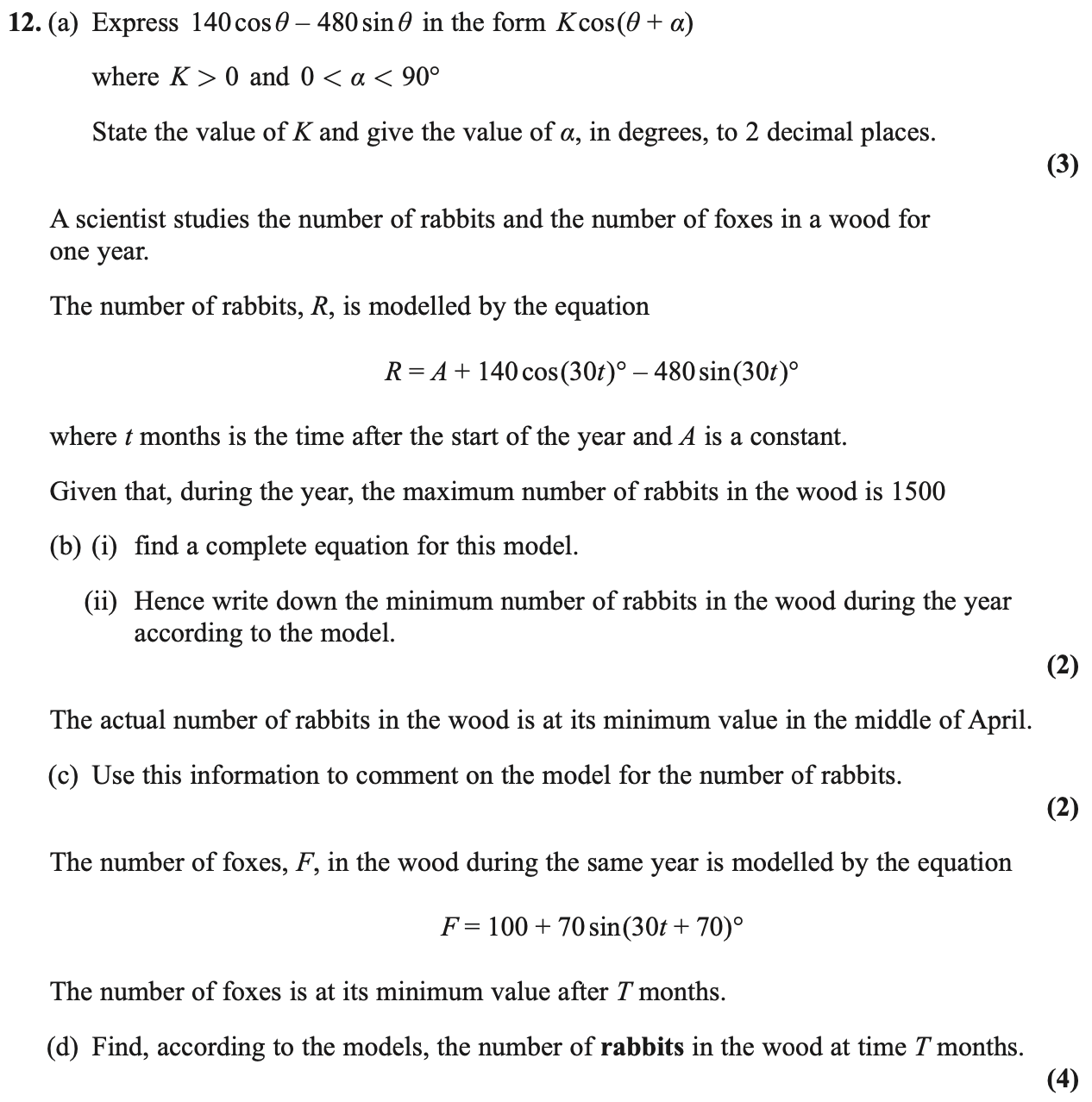
16Edexcel A Level June 2024 Paper 1 Q12
(a) Express 140cos(theta) - 480sin(theta) in the form Kcos(theta + alpha), where K > 0 and 0 < alpha < 90deg. State the value of K and give the value of alpha, in degrees, to 2 decimal places. (3) A scientist studies the number of rabbits and the number of foxes in a wood for one year. The number of rabbits, R, is modelled by the equation R = A + 140cos(30t)deg - 480sin(30t)deg, where t months is the time after the start of the year and A is a constant. Given that, during the year, the maximum number of rabbits in the wood is 1500, (b) (i) find a complete equation for this model. (ii) Hence write down the minimum number of rabbits in the wood during the year according to the model. (2) The actual number of rabbits in the wood is at its minimum value in the middle of April. (c) Use this information to comment on the model for the number of rabbits. (2) The number of foxes, F, in the wood during the same year is modelled by the equation F = 100 + 70sin(30t + 70)deg. The number of foxes is at its minimum value after T months. (d) Find, according to the models, the number of rabbits in the wood at time T months. (4)