22 real exam questions with step-by-step video solutions · Try each question yourself first, then open the video solution to check your working. Stuck? Ask Axi below – it knows this page’s questions.
New · Axi
Stuck on an integration question?
Axi, our AI tutor, answers questions on any integration problem on this page – no copying, no pasting, no sign-up.
What are you stuck on? Ask about any integration question on this page and I will talk you through it.
Axi answers from this page’s question, tutorial and worked solution. Live Axi reads and marks your own working in the app.
1EDEXCEL C4 June 2012 Q7
Figure 3 shows a sketch of part of the curve with equation y = x^(1/2) ln 2x. The finite region R, shown shaded in Figure 3, is bounded by the curve, the x-axis and the lines x = 1 and x = 4. (a) Use the trapezium rule, with 3 strips of equal width, to find an estimate for the area of R, giving your answer to 2 decimal places. (4) (b) Find the integral of x^(1/2) ln 2x dx. (4) (c) Hence find the exact area of R, giving your answer in the form a ln 2 + b, where a and b are exact constants. (3)
View video solution (3 parts)
Part (a):
Part (b):
Part (c):
2EDEXCEL C4 January 2012 Q2
(a) Use integration by parts to find the integral of x sin 3x dx. (3) (b) Using your answer to part (a), find the integral of x^2 cos 3x dx. (3)
View video solution (2 parts)
Part (a):
Part (b):
3EDEXCEL C4 January 2012 Q6
Figure 3 shows a sketch of the curve with equation y = 2 sin 2x / (1 + cos x), 0 <= x <= pi/2. The finite region R, shown shaded in Figure 3, is bounded by the curve and the x-axis. The table below shows corresponding values of x and y for y = 2 sin 2x / (1 + cos x): x = 0, pi/8, pi/4, 3pi/8, pi/2 with y = 0, blank, 1.17157, 1.02280, 0. (a) Complete the table above giving the missing value of y to 5 decimal places. (1) (b) Use the trapezium rule, with all the values of y in the completed table, to obtain an estimate for the area of R, giving your answer to 4 decimal places. (3) (c) Using the substitution u = 1 + cos x, or otherwise, show that the integral of 2 sin 2x / (1 + cos x) dx = 4 ln(1 + cos x) - 4 cos x + k, where k is a constant. (5) (d) Hence calculate the error of the estimate in part (b), giving your answer to 2 significant figures. (3)
View video solution (3 parts)
Part (a):
Part (b):
Part (c):
4EDEXCEL C4 June 2011 Q4
Figure 2 shows a sketch of the curve with equation y = x^3 ln(x^2 + 2), x >= 0. The finite region R, shown shaded in Figure 2, is bounded by the curve, the x-axis and the line x = sqrt(2). The table below shows corresponding values of x and y for y = x^3 ln(x^2 + 2): x = 0, sqrt(2)/4, sqrt(2)/2, 3 sqrt(2)/4, sqrt(2) with y = 0, blank, 0.3240, blank, 3.9210. (a) Complete the table above giving the missing values of y to 4 decimal places. (2) (b) Use the trapezium rule, with all the values of y in the completed table, to obtain an estimate for the area of R, giving your answer to 2 decimal places. (3) (c) Use the substitution u = x^2 + 2 to show that the area of R is (1/2) times the integral from 2 to 4 of (u - 2) ln u du. (4) (d) Hence, or otherwise, find the exact area of R. (6)
View video solution (3 parts)
Part (a):
Part (b):
Part (c):
5EDEXCEL C4 June 2011 Q8
(a) Find the integral of (4y + 3)^(-1/2) dy. (2) (b) Given that y = 1.5 at x = -2, solve the differential equation dy/dx = sqrt(4y + 3) / x^2, giving your answer in the form y = f(x). (6)
View video solution (2 parts)
Part (a):
Part (b):
6EDEXCEL C4 January 2011 Q1
Use integration to find the exact value of the integral from 0 to pi/2 of x sin 2x dx. (6)
View video solution (1 part)
Part (a):
7EDEXCEL C4 January 2011 Q3
(a) Express 5 / ((x - 1)(3x + 2)) in partial fractions. (3) (b) Hence find the integral of 5 / ((x - 1)(3x + 2)) dx, where x > 1. (3) (c) Find the particular solution of the differential equation (x - 1)(3x + 2) dy/dx = 5y, x > 1, for which y = 8 at x = 2. Give your answer in the form y = f(x). (6)
View video solution (3 parts)
Part (a):
Part (b):
Part (c):
8EDEXCEL C4 January 2011 Q7
I = integral from 2 to 5 of 1 / (4 + sqrt(x - 1)) dx. (a) Given that y = 1 / (4 + sqrt(x - 1)), complete the table below with values of y corresponding to x = 3 and x = 5. Give your values to 4 decimal places: x = 2, 3, 4, 5 with y = 0.2, blank, 0.1745, blank. (2) (b) Use the trapezium rule, with all of the values of y in the completed table, to obtain an estimate of I, giving your answer to 3 decimal places. (4) (c) Using the substitution x = (u - 4)^2 + 1, or otherwise, and integrating, find the exact value of I. (8)
View video solution (2 parts)
Part (a):
Part (b):
9EDEXCEL C4 June 2010 Q2
Using the substitution u = cos x + 1, or otherwise, show that the integral from 0 to pi/2 of e^(cos x + 1) sin x dx = e(e - 1). (6)
View video solution (1 part)
Part (a):
10EDEXCEL C4 June 2010 Q6
f(theta) = 4 cos^2 theta - 3 sin^2 theta. (a) Show that f(theta) = 1/2 + (7/2) cos 2theta. (3) (b) Hence, using calculus, find the exact value of the integral from 0 to pi/2 of theta f(theta) dtheta. (7)
View video solution (2 parts)
Part (a):
Part (b):
11EDEXCEL C4 January 2010 Q2
Figure 1 shows a sketch of the curve with equation y = x ln x, x >= 1. The finite region R, shown shaded in Figure 1, is bounded by the curve, the x-axis and the line x = 4. The table shows corresponding values of x and y for y = x ln x: x = 1, 1.5, 2, 2.5, 3, 3.5, 4 with y = 0, 0.608, blank, blank, 3.296, 4.385, 5.545. (a) Complete the table with the values of y corresponding to x = 2 and x = 2.5, giving your answers to 3 decimal places. (2) (b) Use the trapezium rule, with all the values of y in the completed table, to obtain an estimate for the area of R, giving your answer to 2 decimal places. (4) (c) (i) Use integration by parts to find the integral of x ln x dx. (ii) Hence find the exact area of R, giving your answer in the form (1/4)(a ln 2 + b), where a and b are integers. (7)
View video solution (3 parts)
Part (a):
Part (b):
Part (c):
12EDEXCEL C4 January 2010 Q5
(a) Find the integral of (9x + 6)/x dx, x > 0. (2) (b) Given that y = 8 at x = 1, solve the differential equation dy/dx = ((9x + 6) y^(1/3)) / x, giving your answer in the form y^2 = g(x). (6)
View video solution (2 parts)
Part (a):
Part (b):
13EDEXCEL C4 January 2010 Q8
(a) Using the substitution x = 2 cos u, or otherwise, find the exact value of the integral from 1 to sqrt(2) of 1 / (x^2 sqrt(4 - x^2)) dx. (7) Figure 3 shows a sketch of part of the curve with equation y = 4 / (x (4 - x^2)^(1/4)), 0 < x < 2. The shaded region S, shown in Figure 3, is bounded by the curve, the x-axis and the lines with equations x = 1 and x = sqrt(2). The shaded region S is rotated through 2pi radians about the x-axis to form a solid of revolution. (b) Using your answer to part (a), find the exact volume of the solid of revolution formed. (3)
View video solution (2 parts)
Part (a):
Part (b):
14EDEXCEL C4 June 2009 Q3
f(x) = (4 - 2x) / ((2x + 1)(x + 1)(x + 3)) = A/(2x + 1) + B/(x + 1) + C/(x + 3). (a) Find the values of the constants A, B and C. (4) (b) (i) Hence find the integral of f(x) dx. (3) (ii) Find the integral from 0 to 2 of f(x) dx in the form ln k, where k is a constant. (3)
View video solution (3 parts)
Part (a):
Part (b):
Part (c):
15EDEXCEL C4 June 2009 Q6
(a) Find the integral of sqrt(5 - x) dx. (2) Figure 3 shows a sketch of the curve with equation y = (x - 1) sqrt(5 - x), 1 <= x <= 5. (b) (i) Using integration by parts, or otherwise, find the integral of (x - 1) sqrt(5 - x) dx. (4) (ii) Hence find the integral from 1 to 5 of (x - 1) sqrt(5 - x) dx. (2)
View video solution (3 parts)
Part (a):
Part (b):
Part (c):
16EDEXCEL C4 January 2009 Q6
(a) Find the integral of tan^2 x dx. (2) (b) Use integration by parts to find the integral of (1/x^3) ln x dx. (4) (c) Use the substitution u = 1 + e^x to show that the integral of e^(3x) / (1 + e^x) dx = (1/2) e^(2x) - e^x + ln(1 + e^x) + k, where k is a constant. (7)
View video solution (3 parts)
Part (a):
Part (b):
Part (c):
17EDEXCEL C4 June 2008 Q2
(a) Use integration by parts to find the integral of x e^x dx. (3) (b) Hence find the integral of x^2 e^x dx. (3)
View video solution (2 parts)
Part (a):
Part (b):
18EDEXCEL C4 June 2008 Q8
Figure 3 shows the curve C with parametric equations x = 8 cos t, y = 4 sin 2t, 0 <= t <= pi/2. The point P lies on C and has coordinates (4, 2 sqrt(3)). (a) Find the value of t at the point P. (2) The line l is a normal to C at P. (b) Show that an equation for l is y = -x sqrt(3) + 6 sqrt(3). (6) The finite region R is enclosed by the curve C, the x-axis and the line x = 4, as shown shaded in Figure 3. (c) Show that the area of R is given by the integral from pi/3 to pi/2 of 64 sin^2 t cos t dt. (4) (d) Use this integral to find the area of R, giving your answer in the form a + b sqrt(3), where a and b are constants to be determined. (4)
View video solution (4 parts)
Part (a):
Part (b):
Part (c):
Part (d):
19EDEXCEL C4 January 2008 Q4
(i) Find the integral of ln(x/2) dx. (4) (ii) Find the exact value of the integral from pi/4 to pi/2 of sin^2 x dx. (5)
View video solution (3 parts)
Part (a):
Part (b):
Part (c):
20Edexcel A Level June 2023 Paper 2 Q5
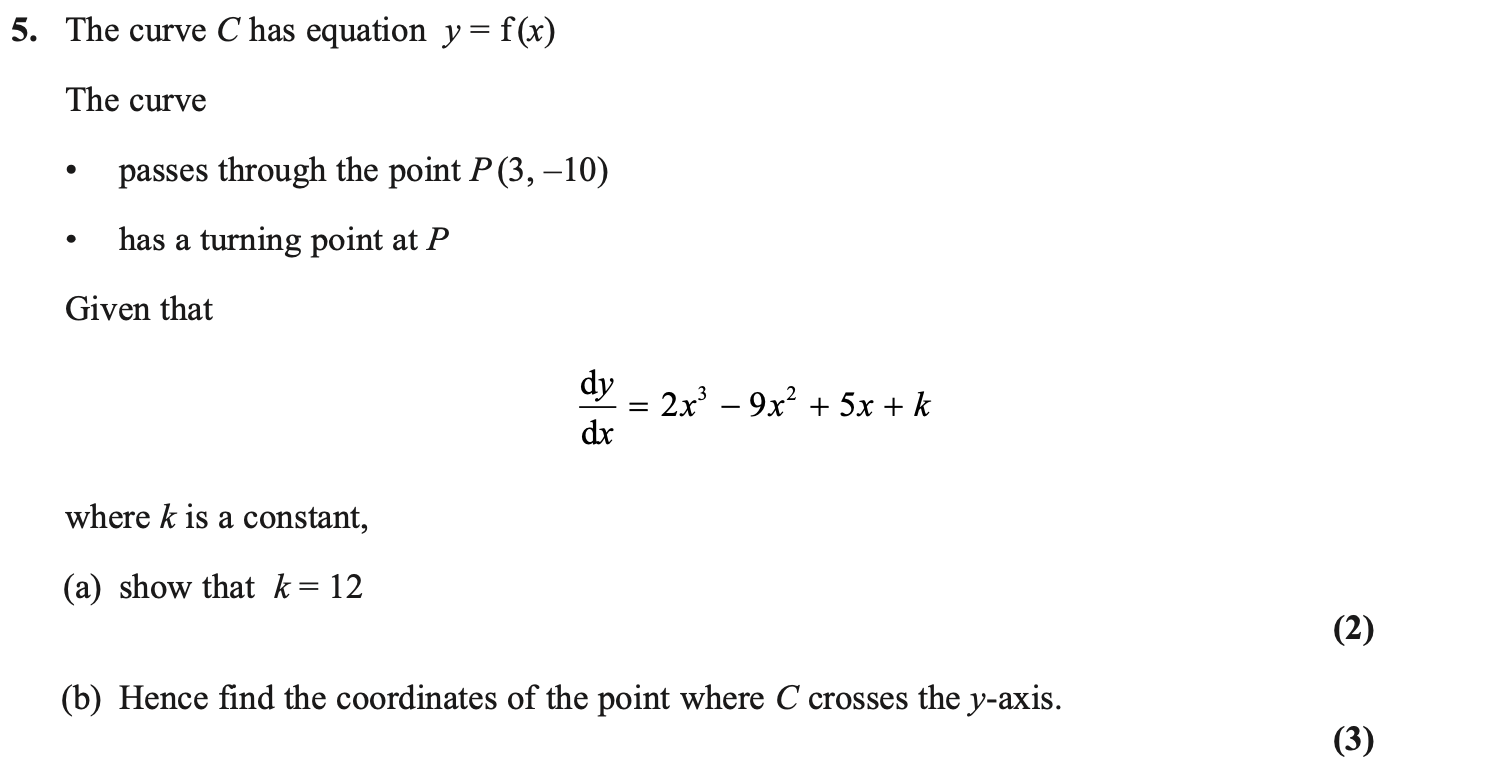
The curve C has equation y = f(x). The curve passes through the point P (3, -10) and has a turning point at P. Given that dy/dx = 2x^3 - 9x^2 + 5x + k, where k is a constant, (a) show that k = 12 (2) (b) Hence find the coordinates of the point where C crosses the y-axis. (3)
21EDEXCEL C4 January 2008 Q7
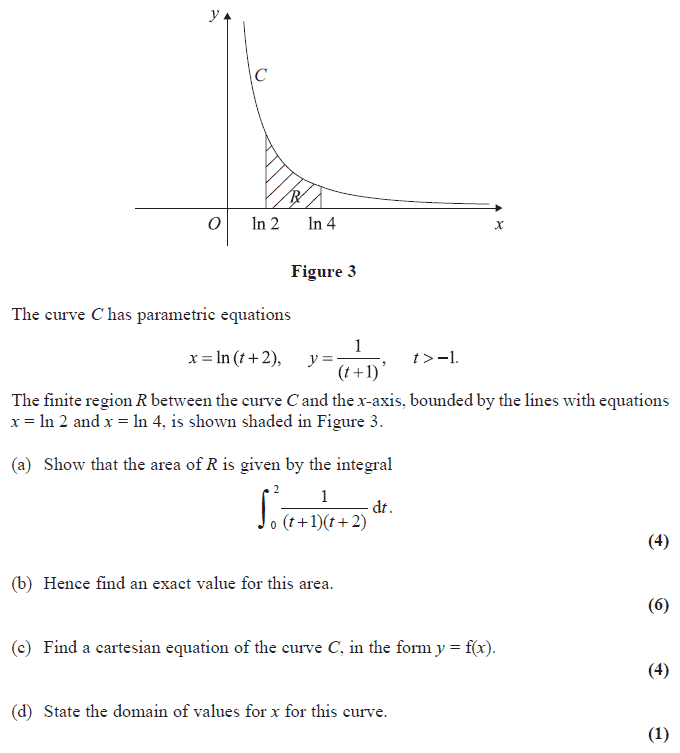
Figure 3. The curve C has parametric equations x = ln(t + 2), y = 1/(t + 1), t > -1. The finite region R between the curve C and the x-axis, bounded by the lines with equations x = ln 2 and x = ln 4, is shown shaded in Figure 3. (a) Show that the area of R is given by the integral from 0 to 2 of 1 / ((t + 1)(t + 2)) dt. (4) (b) Hence find an exact value for this area. (6) (c) Find a cartesian equation of the curve C, in the form y = f(x). (4) (d) State the domain of values for x for this curve. (1)
View video solution (4 parts)
Part (a):
Part (b):
Part (c):
Part (d):
22EDEXCEL C4 January 2008 Q8
Liquid is pouring into a large vertical circular cylinder at a constant rate of 1600 cm^3/s and is leaking out of a hole in the base, at a rate proportional to the square root of the height of the liquid already in the cylinder. The area of the circular cross section of the cylinder is 4000 cm^2. (a) Show that at time t seconds, the height h cm of liquid in the cylinder satisfies the differential equation dh/dt = 0.4 - k sqrt(h), where k is a positive constant. (3) When h = 25, water is leaking out of the hole at 400 cm^3/s. (b) Show that k = 0.02. (1) (c) Separate the variables of the differential equation dh/dt = 0.4 - 0.02 sqrt(h), to show that the time taken to fill the cylinder from empty to a height of 100 cm is given by the integral from 0 to 100 of 50 / (20 - sqrt(h)) dh. (2) Using the substitution h = (20 - x)^2, or otherwise, (d) find the exact value of the integral from 0 to 100 of 50 / (20 - sqrt(h)) dh. (6) (e) Hence find the time taken to fill the cylinder from empty to a height of 100 cm, giving your answer in minutes and seconds to the nearest second. (1)