12 real exam questions with step-by-step video solutions · Try each question yourself first, then open the video solution to check your working. Stuck? Ask Axi below – it knows this page’s questions.
New · Axi
Stuck on an iteration question?
Axi, our AI tutor, answers questions on any iteration problem on this page – no copying, no pasting, no sign-up.
What are you stuck on? Ask about any iteration question on this page and I will talk you through it.
Axi answers from this page’s question, tutorial and worked solution. Live Axi reads and marks your own working in the app.
1Edexcel A Level June 2018 Paper 1 Q4
The curve with equation y = 2 ln(8 - x) meets the line y = x at a single point, x = alpha. (a) Show that 3 < alpha < 4. (2) Figure 2 shows the graph of y = 2 ln(8 - x) and the graph of y = x. A student uses the iteration formula x_(n+1) = 2 ln(8 - x_n), n in N, in an attempt to find an approximation for alpha. Using the graph and starting with x_1 = 4, (b) determine whether or not this iteration formula can be used to find an approximation for alpha, justifying your answer. (2)
View video solution (2 parts)
Part (a):
Part (b):
2EDEXCEL C3 June 2014 Q6
Figure 2 shows a sketch of part of the curve with equation y = 2 cos((1/2) x^2) + x^3 - 3x - 2. The curve crosses the x-axis at the point Q and has a minimum turning point at R. (a) Show that the x coordinate of Q lies between 2.1 and 2.2. (2) (b) Show that the x coordinate of R is a solution of the equation x = sqrt(1 + (2/3) x sin((1/2) x^2)). (4) Using the iterative formula x_(n+1) = sqrt(1 + (2/3) x_n sin((1/2) x_n^2)), x_0 = 1.3, (c) find the values of x_1 and x_2 to 3 decimal places. (2)
View video solution (3 parts)
Part (a):
Part (b):
Part (c):
3EDEXCEL C3 June 2013 Q4
f(x) = 25x^2 e^(2x) - 16, x in R. (a) Using calculus, find the exact coordinates of the turning points on the curve with equation y = f(x). (5) (b) Show that the equation f(x) = 0 can be written as x = +/- (4/5) e^(-x). (1) The equation f(x) = 0 has a root alpha, where alpha = 0.5 to 1 decimal place. (c) Starting with x_0 = 0.5, use the iteration formula x_(n+1) = (4/5) e^(-x_n) to calculate the values of x_1, x_2 and x_3, giving your answers to 3 decimal places. (3) (d) Give an accurate estimate for alpha to 2 decimal places, and justify your answer. (2)
View video solution (4 parts)
Part (a):
Part (b):
Part (c):
Part (d):
4OCR C3 June 2013 Q7
The diagram shows the curve y = f(x), where f is the function defined for all real values of x by f(x) = 3 + 4e^(-x). (i) State the range of f. [1] (ii) Find an expression for f^(-1)(x), and state the domain and range of f^(-1). [4] (iii) The straight line y = x meets the curve y = f(x) at the point P. By using an iterative process based on the equation x = f(x), with a starting value of 3, find the coordinates of the point P. Show all your working and give each coordinate correct to 3 decimal places. [4] (iv) How is the point P related to the curves y = f(x) and y = f^(-1)(x)? [1]
View video solution (4 parts)
Part (a):
Part (b):
Part (c):
Part (d):
5EDEXCEL C3 January 2013 Q2
g(x) = e^(x-1) + x - 6. (a) Show that the equation g(x) = 0 can be written as x = ln(6 - x) + 1, x < 6. (2) The root of g(x) = 0 is alpha. The iterative formula x_(n+1) = ln(6 - x_n) + 1, x_0 = 2, is used to find an approximate value for alpha. (b) Calculate the values of x_1, x_2 and x_3 to 4 decimal places. (3) (c) By choosing a suitable interval, show that alpha = 2.307 correct to 3 decimal places. (3)
View video solution (1 part)
Part (a):
6OCR C3 January 2013 Q6
(i) By sketching the curves y = ln x and y = 8 - 2x^2 on a single diagram, show that the equation ln x = 8 - 2x^2 has exactly one real root. [3] (ii) Explain how your diagram shows that the root is between 1 and 2. [1] (iii) Use the iterative formula x_(n+1) = sqrt(4 - (1/2) ln x_n), with a suitable starting value, to find the root. Show all your working and give the root correct to 3 decimal places. [4] (iv) The curves y = ln x and y = 8 - 2x^2 are each translated by 2 units in the positive x-direction and then stretched by scale factor 4 in the y-direction. Find the coordinates of the point where the new curves intersect, giving each coordinate correct to 2 decimal places. [3]
View video solution (1 part)
Part (a):
7EDEXCEL C3 January 2012 Q6
f(x) = x^2 - 3x + 2 cos((1/2) x), 0 <= x <= pi. (a) Show that the equation f(x) = 0 has a solution in the interval 0.8 < x < 0.9. (2) The curve with equation y = f(x) has a minimum point P. (b) Show that the x-coordinate of P is the solution of the equation x = (3 + sin((1/2) x))/2. (4) (c) Using the iteration formula x_(n+1) = (3 + sin((1/2) x_n))/2, x_0 = 2, find the values of x_1, x_2 and x_3, giving your answers to 3 decimal places. (3) (d) By choosing a suitable interval, show that the x-coordinate of P is 1.9078 correct to 4 decimal places. (3)
View video solution (4 parts)
Part (a):
Part (b):
Part (c):
Part (d):
8EDEXCEL C3 June 2011 Q2
f(x) = 2 sin(x^2) + x - 2, 0 <= x < 2pi. (a) Show that f(x) = 0 has a root alpha between x = 0.75 and x = 0.85. (2) The equation f(x) = 0 can be written as x = [arcsin(1 - 0.5x)]^(1/2). (b) Use the iterative formula x_(n+1) = [arcsin(1 - 0.5x_n)]^(1/2), x_0 = 0.8, to find the values of x_1, x_2 and x_3, giving your answers to 5 decimal places. (3) (c) Show that alpha = 0.80157 is correct to 5 decimal places. (3)
View video solution (3 parts)
Part (a):
Part (b):
Part (c):
9EDEXCEL C3 January 2011 Q5
Figure 1 shows a sketch of part of the curve with equation y = f(x), where f(x) = (8 - x) ln x, x > 0. The curve cuts the x-axis at the points A and B and has a maximum turning point at Q, as shown in Figure 1. (a) Write down the coordinates of A and the coordinates of B. (2) (b) Find f'(x). (3) (c) Show that the x-coordinate of Q lies between 3.5 and 3.6. (2) (d) Show that the x-coordinate of Q is the solution of x = 8/(1 + ln x). (3) To find an approximation for the x-coordinate of Q, the iteration formula x_(n+1) = 8/(1 + ln x_n) is used. (e) Taking x_0 = 3.55, find the values of x_1, x_2 and x_3. Give your answers to 3 decimal places. (3)
View video solution (5 parts)
Part (a):
Part (b):
Part (c):
Part (d):
Part (e):
10EDEXCEL C3 June 2010 Q3
f(x) = 4 cosec x - 4x + 1, where x is in radians. (a) Show that there is a root alpha of f(x) = 0 in the interval [1.2, 1.3]. (2) (b) Show that the equation f(x) = 0 can be written in the form x = 1/sin x + 1/4. (2) (c) Use the iterative formula x_(n+1) = 1/sin x_n + 1/4, x_0 = 1.25, to calculate the values of x_1, x_2 and x_3, giving your answers to 4 decimal places. (3) (d) By considering the change of sign of f(x) in a suitable interval, verify that alpha = 1.291 correct to 3 decimal places. (2)
View video solution (4 parts)
Part (a):
Part (b):
Part (c):
Part (d):
11Edexcel A Level June 2019 Paper 2 Q11
Figure 8 shows a sketch of the curve C with equation y = x^x, x > 0. (a) Find, by firstly taking logarithms, the x coordinate of the turning point of C. (Solutions based entirely on graphical or numerical methods are not acceptable.) (5) The point P(alpha, 2) lies on C. (b) Show that 1.5 < alpha < 1.6. (2) A possible iteration formula that could be used in an attempt to find alpha is x_(n+1) = 2 x_n^(1 - x_n). Using this formula with x_1 = 1.5, (c) find x_4 to 3 decimal places, (2) (d) describe the long-term behaviour of x_n. (2)
View video solution (1 part)
Part (a):
13Edexcel A Level June 2025 Paper 1 Q9
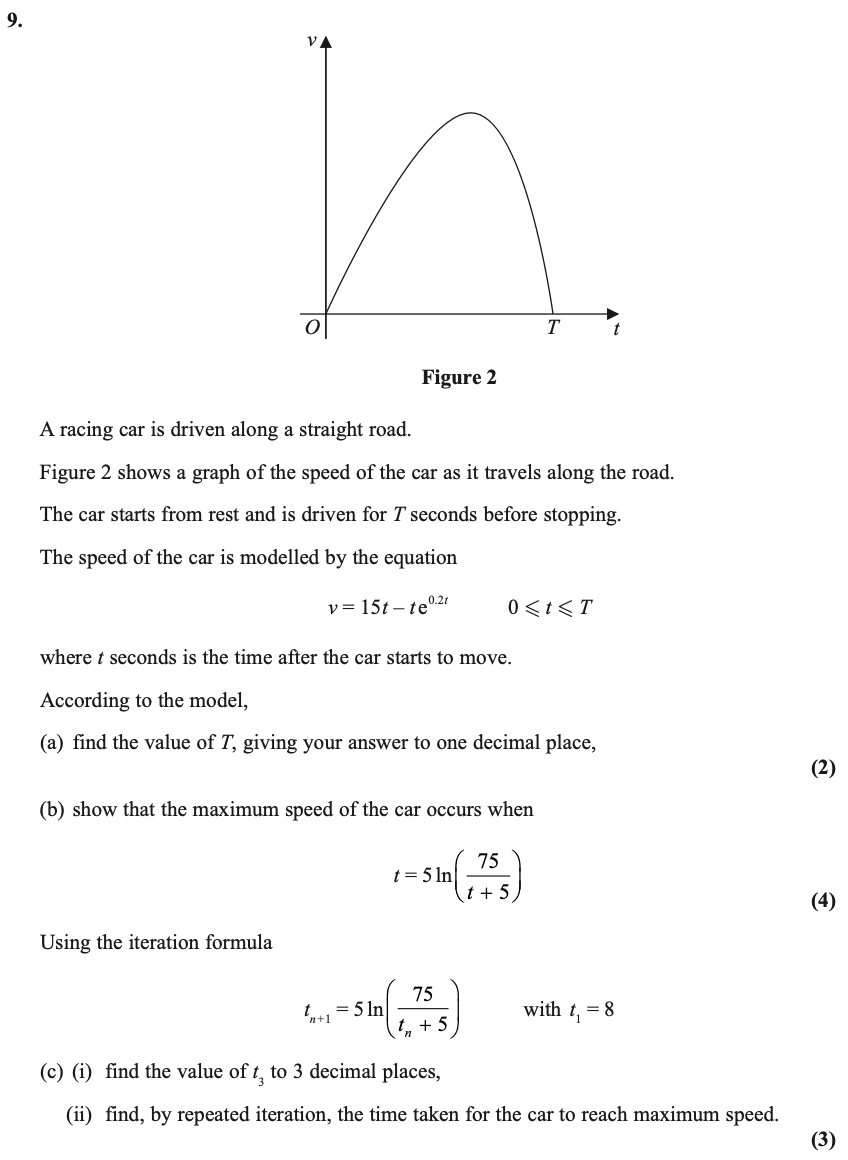
A racing car is driven along a straight road. Figure 2 shows a graph of the speed of the car as it travels along the road. The car starts from rest and is driven for T seconds before stopping. The speed of the car is modelled by the equation v = 15t - t e^0.2t, 0 <= t <= T, where t seconds is the time after the car starts to move. According to the model, (a) find the value of T, giving your answer to one decimal place, (2) (b) show that the maximum speed of the car occurs when t = 5 ln(75/(t + 5)) (4) Using the iteration formula t(n+1) = 5 ln(75/(t(n) + 5)) with t(1) = 8, (c)(i) find the value of t(3) to 3 decimal places, (ii) find, by repeated iteration, the time taken for the car to reach maximum speed. (3)
View video solution (1 part)
Part (a):
12Edexcel A Level June 2023 Paper 1 Q15
A curve has equation y = f(x), where f(x) = 7x e^x / sqrt(e^(3x) - 2), x > ln(cube root of 2). (a) Show that f'(x) = 7 e^x (e^(3x) (2 - x) + Ax + B) / (2 (e^(3x) - 2)^(3/2)), where A and B are constants to be found. (5) (b) Hence show that the x coordinates of the turning points of the curve are solutions of the equation x = (2e^(3x) - 4)/(e^(3x) + 4). (2) The equation x = (2e^(3x) - 4)/(e^(3x) + 4) has two positive roots alpha and beta where beta > alpha. A student uses the iteration formula x_(n+1) = (2e^(3x_n) - 4)/(e^(3x_n) + 4) in an attempt to find approximations for alpha and beta. Diagram 1 shows a plot of part of the curve with equation y = (2e^(3x) - 4)/(e^(3x) + 4) and part of the line with equation y = x. Using Diagram 1 on page 42, (c) draw a staircase diagram to show that the iteration formula starting with x_1 = 1 can be used to find an approximation for beta. (1) Use the iteration formula with x_1 = 1, to find, to 3 decimal places, (d) (i) the value of x_2, (ii) the value of beta. (3) Using a suitable interval and a suitable function that should be stated, (e) show that alpha = 0.432 to 3 decimal places. (2) Only use the copy of Diagram 1 if you need to redraw your answer to part (c).