13 real exam questions with step-by-step video solutions · Try each question yourself first, then open the video solution to check your working. Stuck? Ask Axi below – it knows this page’s questions.
New · Axi
Stuck on a substitution question?
Axi, our AI tutor, answers questions on any integration by substitution problem on this page – no copying, no pasting. Free account, no card.
What are you stuck on? Ask about any substitution question on this page and I will talk you through it.
Axi answers from this page’s question, tutorial and worked solution. Live Axi reads and marks your own working in the app.
1EDEXCEL C4 June 2013 Q5
(a) Use the substitution x = u^2, u > 0, to show that the integral of 1 / (x(2 sqrt(x) - 1)) dx = the integral of 2 / (u(2u - 1)) du. (3) (b) Hence show that the integral from 1 to 9 of 1 / (x(2 sqrt(x) - 1)) dx = 2 ln(a/b), where a and b are integers to be determined. (7)
View video solution (2 parts)
Part (a):
Part (b):
2OCR C4 June 2013 Q6
Use the substitution u = 1 + ln x to find the integral of ln x / (x(1 + ln x)^2) dx. [6]
View video solution (1 part)
Part (a):
3EDEXCEL C4 January 2013 Q4
Figure 1 shows a sketch of part of the curve with equation y = x / (1 + sqrt(x)). The finite region R, shown shaded in Figure 1, is bounded by the curve, the x-axis, the line with equation x = 1 and the line with equation x = 4. (a) Complete the table with the value of y corresponding to x = 3, giving your answer to 4 decimal places. (1) Table: x = 1, 2, 3, 4 with y = 0.5, 0.8284, blank, 1.3333. (b) Use the trapezium rule, with all the values of y in the completed table, to obtain an estimate of the area of the region R, giving your answer to 3 decimal places. (3) (c) Use the substitution u = 1 + sqrt(x), to find, by integrating, the exact area of R. (8)
View video solution (2 parts)
Part (a):
Part (b):
4EDEXCEL C4 January 2012 Q6
Figure 3 shows a sketch of the curve with equation y = 2 sin 2x / (1 + cos x), 0 <= x <= pi/2. The finite region R, shown shaded in Figure 3, is bounded by the curve and the x-axis. The table below shows corresponding values of x and y for y = 2 sin 2x / (1 + cos x): x = 0, pi/8, pi/4, 3pi/8, pi/2 with y = 0, blank, 1.17157, 1.02280, 0. (a) Complete the table above giving the missing value of y to 5 decimal places. (1) (b) Use the trapezium rule, with all the values of y in the completed table, to obtain an estimate for the area of R, giving your answer to 4 decimal places. (3) (c) Using the substitution u = 1 + cos x, or otherwise, show that the integral of 2 sin 2x / (1 + cos x) dx = 4 ln(1 + cos x) - 4 cos x + k, where k is a constant. (5) (d) Hence calculate the error of the estimate in part (b), giving your answer to 2 significant figures. (3)
View video solution (3 parts)
Part (a):
Part (b):
Part (c):
5EDEXCEL C4 June 2011 Q4
Figure 2 shows a sketch of the curve with equation y = x^3 ln(x^2 + 2), x >= 0. The finite region R, shown shaded in Figure 2, is bounded by the curve, the x-axis and the line x = sqrt(2). The table below shows corresponding values of x and y for y = x^3 ln(x^2 + 2): x = 0, sqrt(2)/4, sqrt(2)/2, 3 sqrt(2)/4, sqrt(2) with y = 0, blank, 0.3240, blank, 3.9210. (a) Complete the table above giving the missing values of y to 4 decimal places. (2) (b) Use the trapezium rule, with all the values of y in the completed table, to obtain an estimate for the area of R, giving your answer to 2 decimal places. (3) (c) Use the substitution u = x^2 + 2 to show that the area of R is (1/2) times the integral from 2 to 4 of (u - 2) ln u du. (4) (d) Hence, or otherwise, find the exact area of R. (6)
View video solution (3 parts)
Part (a):
Part (b):
Part (c):
6EDEXCEL C4 January 2011 Q7
I = integral from 2 to 5 of 1 / (4 + sqrt(x - 1)) dx. (a) Given that y = 1 / (4 + sqrt(x - 1)), complete the table below with values of y corresponding to x = 3 and x = 5. Give your values to 4 decimal places: x = 2, 3, 4, 5 with y = 0.2, blank, 0.1745, blank. (2) (b) Use the trapezium rule, with all of the values of y in the completed table, to obtain an estimate of I, giving your answer to 3 decimal places. (4) (c) Using the substitution x = (u - 4)^2 + 1, or otherwise, and integrating, find the exact value of I. (8)
View video solution (2 parts)
Part (a):
Part (b):
7EDEXCEL C4 June 2010 Q2
Using the substitution u = cos x + 1, or otherwise, show that the integral from 0 to pi/2 of e^(cos x + 1) sin x dx = e(e - 1). (6)
View video solution (1 part)
Part (a):
8EDEXCEL C4 January 2010 Q8
(a) Using the substitution x = 2 cos u, or otherwise, find the exact value of the integral from 1 to sqrt(2) of 1 / (x^2 sqrt(4 - x^2)) dx. (7) Figure 3 shows a sketch of part of the curve with equation y = 4 / (x (4 - x^2)^(1/4)), 0 < x < 2. The shaded region S, shown in Figure 3, is bounded by the curve, the x-axis and the lines with equations x = 1 and x = sqrt(2). The shaded region S is rotated through 2pi radians about the x-axis to form a solid of revolution. (b) Using your answer to part (a), find the exact volume of the solid of revolution formed. (3)
View video solution (2 parts)
Part (a):
Part (b):
9Edexcel A Level June 2019 Paper 2 Q14
(a) Use the substitution u = 4 - sqrt(h) to show that the integral of dh / (4 - sqrt(h)) = -8 ln|4 - sqrt(h)| - 2 sqrt(h) + k, where k is a constant. (6) A team of scientists is studying a species of slow growing tree. The rate of change in height of a tree in this species is modelled by the differential equation dh/dt = t^0.25 (4 - sqrt(h)) / 20, where h is the height in metres and t is the time, measured in years, after the tree is planted. (b) Find, according to the model, the range in heights of trees in this species. (2) One of these trees is one metre high when it is first planted. According to the model, (c) calculate the time this tree would take to reach a height of 12 metres, giving your answer to 3 significant figures. (7)
View video solution (1 part)
Part (a):
10EDEXCEL C4 June 2009 Q6
(a) Find the integral of sqrt(5 - x) dx. (2) Figure 3 shows a sketch of the curve with equation y = (x - 1) sqrt(5 - x), 1 <= x <= 5. (b) (i) Using integration by parts, or otherwise, find the integral of (x - 1) sqrt(5 - x) dx. (4) (ii) Hence find the integral from 1 to 5 of (x - 1) sqrt(5 - x) dx. (2)
View video solution (3 parts)
Part (a):
Part (b):
Part (c):
11Edexcel A Level June 2023 Paper 2 Q13
In this question you must show all stages of your working. Solutions relying entirely on calculator technology are not acceptable. (a) Find the first three terms, in ascending powers of x, of the binomial expansion of (3 + x)^(-2), writing each term in simplest form. (4) (b) Using the answer to part (a) and using algebraic integration, estimate the value of the integral from 0.2 to 0.4 of 6x / (3 + x)^2 dx, giving your answer to 4 significant figures. (4) (c) Find, using algebraic integration, the exact value of the integral from 0.2 to 0.4 of 6x / (3 + x)^2 dx, giving your answer in the form a ln b + c, where a, b and c are constants to be found. (5)
12EDEXCEL C4 January 2009 Q6
(a) Find the integral of tan^2 x dx. (2) (b) Use integration by parts to find the integral of (1/x^3) ln x dx. (4) (c) Use the substitution u = 1 + e^x to show that the integral of e^(3x) / (1 + e^x) dx = (1/2) e^(2x) - e^x + ln(1 + e^x) + k, where k is a constant. (7)
View video solution (3 parts)
Part (a):
Part (b):
Part (c):
13Edexcel A Level June 2024 Paper 1 Q13
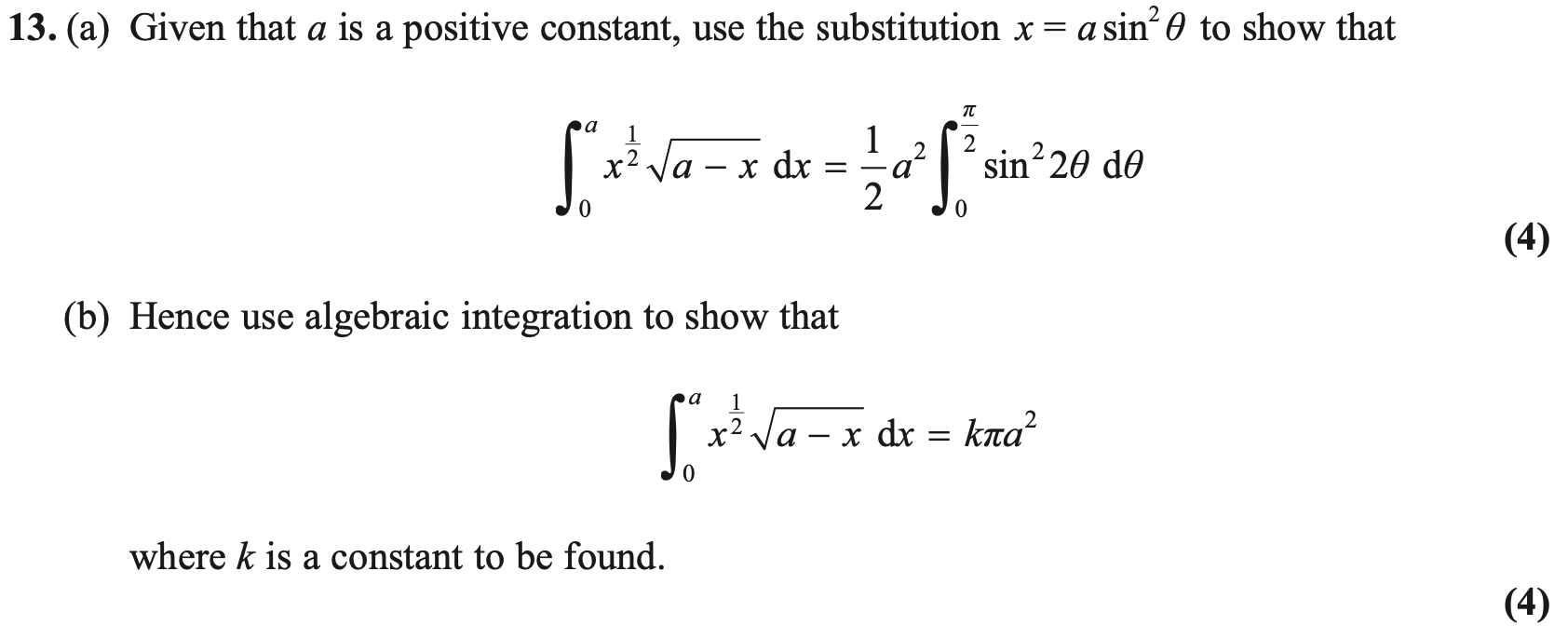
(a) Given that a is a positive constant, use the substitution x = a sin^2 theta to show that the integral from 0 to a of x^(1/2) sqrt(a - x) dx = (1/2) a^2 times the integral from 0 to pi/2 of sin^2 2theta dtheta. (4) (b) Hence use algebraic integration to show that the integral from 0 to a of x^(1/2) sqrt(a - x) dx = k pi a^2, where k is a constant to be found. (4)