21 real exam questions with step-by-step video solutions · Try each question yourself first, then open the video solution to check your working. Stuck? Ask Axi below – it knows this page’s questions.
New · Axi
Stuck on a vectors question?
Axi, our AI tutor, answers questions on any vector problem on this page – no copying, no pasting, no sign-up.
What are you stuck on? Ask about any vectors question on this page and I will talk you through it.
Axi answers from this page’s question, tutorial and worked solution. Live Axi reads and marks your own working in the app.
1EDEXCEL C4 June 2014 Q8
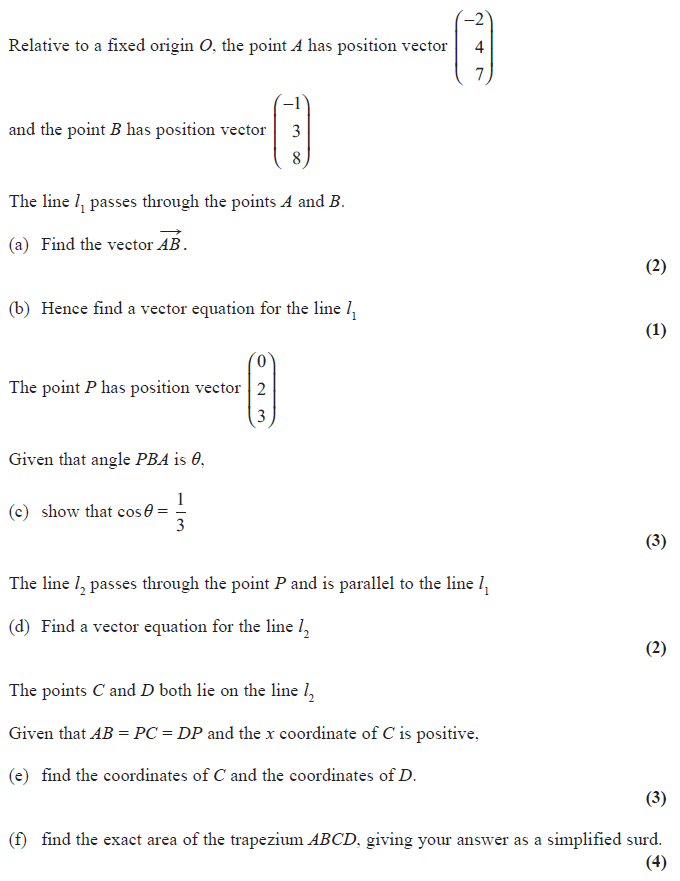
Relative to a fixed origin O, the point A has position vector (-2, 4, 7) and the point B has position vector (-1, 3, 8). The line l1 passes through the points A and B. (a) Find the vector AB. (2) (b) Hence find a vector equation for the line l1. (1) The point P has position vector (0, 2, 3). Given that angle PBA is theta, (c) show that cos theta = 1/3. (3) The line l2 passes through the point P and is parallel to the line l1. (d) Find a vector equation for the line l2. (2) The points C and D both lie on the line l2. Given that AB = PC = DP and the x coordinate of C is positive, (e) find the coordinates of C and the coordinates of D. (3) (f) find the exact area of the trapezium ABCD, giving your answer as a simplified surd. (4)
View video solution (5 parts)
Part (a):
Part (b):
Part (c):
Part (d):
Part (e):
2EDEXCEL C4 June 2013 Q8
With respect to a fixed origin O, the line l has equation r = (13, 8, 1) + lambda(2, 2, -1), where lambda is a scalar parameter. The point A lies on l and has coordinates (3, -2, 6). The point P has position vector (-pi + 2pk) relative to O, where p is a constant. Given that vector PA is perpendicular to l, (a) find the value of p. (4) Given also that B is a point on l such that angle BPA = 45 degrees, (b) find the coordinates of the two possible positions of B. (5)
View video solution (2 parts)
Part (a):
Part (b):
3OCR C4 June 2013 Q7
Points A (2, 2, 5), B (1, -1, -4), C (3, 3, 10) and D (8, 6, 3) are the vertices of a pyramid with a triangular base. (i) Calculate the lengths AB and AC, and the angle BAC. [4] (ii) Show that AD is perpendicular to both AB and AC. [3] (iii) Calculate the volume of the pyramid ABCD. [3] [The volume of the pyramid is V = (1/3) x base area x perpendicular height.]
View video solution (3 parts)
Part (a):
Part (b):
Part (c):
4EDEXCEL C4 January 2013 Q7
With respect to a fixed origin O, the lines l1 and l2 are given by the equations l1: r = (9i + 13j - 3k) + lambda(i + 4j - 2k), l2: r = (2i - j + k) + mu(2i + j + k), where lambda and mu are scalar parameters. (a) Given that l1 and l2 meet, find the position vector of their point of intersection. (5) (b) Find the acute angle between l1 and l2, giving your answer in degrees to 1 decimal place. (3) Given that the point A has position vector 4i + 16j - 3k and that the point P lies on l1 such that AP is perpendicular to l1, (c) find the exact coordinates of P. (6)
View video solution (3 parts)
Part (a):
Part (b):
Part (c):
5EDEXCEL C4 June 2012 Q8
Relative to a fixed origin O, the point A has position vector (10i + 2j + 3k), and the point B has position vector (8i + 3j + 4k). The line l passes through the points A and B. (a) Find the vector AB. (2) (b) Find a vector equation for the line l. (2) The point C has position vector (3i + 12j + 3k). The point P lies on l. Given that the vector CP is perpendicular to l, (c) find the position vector of the point P. (6)
View video solution (2 parts)
Part (a):
Part (b):
6EDEXCEL C4 January 2012 Q7
Relative to a fixed origin O, the point A has position vector (2i - j + 5k), the point B has position vector (5i + 2j + 10k), and the point D has position vector (-i + j + 4k). The line l passes through the points A and B. (a) Find the vector AB. (2) (b) Find a vector equation for the line l. (2) (c) Show that the size of the angle BAD is 109 degrees, to the nearest degree. (4) The points A, B and D, together with a point C, are the vertices of the parallelogram ABCD, where vector AB = vector DC. (d) Find the position vector of C. (2) (e) Find the area of the parallelogram ABCD, giving your answer to 3 significant figures. (3) (f) Find the shortest distance from the point D to the line l, giving your answer to 3 significant figures. (2)
View video solution (6 parts)
Part (a):
Part (b):
Part (c):
Part (d):
Part (e):
Part (f):
7EDEXCEL C4 June 2011 Q6
With respect to a fixed origin O, the lines l1 and l2 are given by the equations l1: r = (6, -3, -2) + lambda(-1, 2, 3), l2: r = (-5, 15, 3) + mu(2, -3, 1), where lambda and mu are scalar parameters. (a) Show that l1 and l2 meet and find the position vector of their point of intersection A. (6) (b) Find, to the nearest 0.1 degree, the acute angle between l1 and l2. (3) The point B has position vector (5, -1, 1). (c) Show that B lies on l1. (1) (d) Find the shortest distance from B to the line l2, giving your answer to 3 significant figures. (4)
View video solution (4 parts)
Part (a):
Part (b):
Part (c):
Part (d):
8EDEXCEL C4 June 2010 Q7
The line l1 has equation r = (2, 3, -4) + lambda(1, 2, 1), where lambda is a scalar parameter. The line l2 has equation r = (0, 9, -3) + mu(5, 0, 2), where mu is a scalar parameter. Given that l1 and l2 meet at the point C, find (a) the coordinates of C. (3) The point A is the point on l1 where lambda = 0 and the point B is the point on l2 where mu = -1. (b) Find the size of the angle ACB. Give your answer in degrees to 2 decimal places. (4) (c) Hence, or otherwise, find the area of the triangle ABC. (5)
View video solution (3 parts)
Part (a):
Part (b):
Part (c):
9EDEXCEL C4 January 2010 Q4
The line l1 has vector equation r = (-6, 4, -1) + lambda(4, -1, 3) and the line l2 has vector equation r = (-6, 4, -1) + mu(3, -4, 1) where lambda and mu are parameters. The lines l1 and l2 intersect at the point A and the acute angle between l1 and l2 is theta. (a) Write down the coordinates of A. (1) (b) Find the value of cos theta. (3) The point X lies on l1 where lambda = 4. (c) Find the coordinates of X. (1) (d) Find the vector AX. (2) (e) Hence, or otherwise, show that |AX| = 4 sqrt(26). (2) The point Y lies on l2. Given that the vector YX is perpendicular to l1, (f) find the length of AY, giving your answer to 3 significant figures. (3)
View video solution (6 parts)
Part (a):
Part (b):
Part (c):
Part (d):
Part (e):
Part (f):
10EDEXCEL C4 June 2009 Q7
Relative to a fixed origin O, the point A has position vector (8i + 13j - 2k), the point B has position vector (10i + 14j - 4k), and the point C has position vector (9i + 9j + 6k). The line l passes through the points A and B. (a) Find a vector equation for the line l. (3) (b) Find |CB|. (2) (c) Find the size of the acute angle between the line segment CB and the line l, giving your answer in degrees to 1 decimal place. (3) (d) Find the shortest distance from the point C to the line l. (3) The point X lies on l. Given that the vector CX is perpendicular to l, (e) find the area of the triangle CXB, giving your answer to 3 significant figures. (3)
View video solution (5 parts)
Part (a):
Part (b):
Part (c):
Part (d):
Part (e):
11EDEXCEL C4 January 2009 Q4
With respect to a fixed origin O the lines l1 and l2 are given by the equations l1: r = (11, 2, 17) + lambda(-2, 1, -4), l2: r = (-5, 11, p) + mu(q, 2, 2), where lambda and mu are parameters and p and q are constants. Given that l1 and l2 are perpendicular, (a) show that q = -3. (2) Given further that l1 and l2 intersect, find (b) the value of p, (6) (c) the coordinates of the point of intersection. (2) The point A lies on l1 and has position vector (9, 3, 13). The point C lies on l2. Given that a circle, with centre C, cuts the line l1 at the points A and B, (d) find the position vector of B. (3)
View video solution (4 parts)
Part (a):
Part (b):
Part (c):
Part (d):
12EDEXCEL C4 June 2008 Q6
With respect to a fixed origin O, the lines l1 and l2 are given by the equations l1: r = (-9i + 10k) + lambda(2i + j - k), l2: r = (3i + j + 17k) + mu(3i - j + 5k), where lambda and mu are scalar parameters. (a) Show that l1 and l2 meet and find the position vector of their point of intersection. (6) (b) Show that l1 and l2 are perpendicular to each other. (2) The point A has position vector 5i + 7j + 3k. (c) Show that A lies on l1. (1) The point B is the image of A after reflection in the line l2. (d) Find the position vector of B. (3)
View video solution (4 parts)
Part (a):
Part (b):
Part (c):
Part (d):
13EDEXCEL C4 January 2008 Q6
The points A and B have position vectors 2i + 6j - k and 3i + 4j + k respectively. The line l1 passes through the points A and B. (a) Find the vector AB. (2) (b) Find a vector equation for the line l1. (2) A second line l2 passes through the origin and is parallel to the vector i + k. The line l1 meets the line l2 at the point C. (c) Find the acute angle between l1 and l2. (3) (d) Find the position vector of the point C. (4)
View video solution (4 parts)
Part (a):
Part (b):
Part (c):
Part (d):
14EDEXCEL C4 June 2007 Q5
The line l1 has equation r = (1, 0, -1) + lambda(1, 1, 0). The line l2 has equation r = (1, 3, 6) + mu(2, 1, -1). (a) Show that l1 and l2 do not meet. (4) The point A is on l1 where lambda = 1, and the point B is on l2 where mu = 2. (b) Find the cosine of the acute angle between AB and l1. (6)
View video solution (2 parts)
Part (a):
Part (b):
15Edexcel A Level June 2022 Paper 2 Q13
Relative to a fixed origin O, the point A has position vector 4i - 3j + 5k, the point B has position vector 4j + 6k, the point C has position vector -16i + pj + 10k, where p is a constant. Given that A, B and C lie on a straight line, (a) find the value of p. (3) The line segment OB is extended to a point D so that vector CD is parallel to vector OA. (b) Find |OD|, writing your answer as a fully simplified surd. (3)
View video solution (1 part)
Part (a):
16Edexcel A Level June 2022 Paper 1 Q9
Figure 3 shows a sketch of a parallelogram PQRS. Given that vector PQ = 2i + 3j - 4k and vector QR = 5i - 2k, (a) show that parallelogram PQRS is a rhombus. (2) (b) Find the exact area of the rhombus PQRS. (4)
View video solution (1 part)
Part (a):
17Edexcel A Level June 2019 Paper 2 Q10
Figure 7 shows a sketch of triangle OAB. The point C is such that vector OC = 2 x vector OA. The point M is the midpoint of AB. The straight line through C and M cuts OB at the point N. Given that vector OA = a and vector OB = b, (a) Find vector CM in terms of a and b. (2) (b) Show that vector ON = (2 - (3/2)lambda)a + (1/2)(lambda)b, where lambda is a scalar constant. (2) (c) Hence prove that ON : NB = 2 : 1. (2)
View video solution (1 part)
Part (a):
18Edexcel A Level June 2023 Paper 1 Q3
Relative to a fixed origin O, the point A has position vector 5i + 3j + 2k, the point B has position vector 2i + 4j + ak, where a is a positive integer. (a) Show that |OA| = sqrt(38). (1) (b) Find the smallest value of a for which |OB| > |OA|. (2)
19Edexcel A Level June 2023 Paper 2 Q6
Relative to a fixed origin O, A is the point with position vector 12i, B is the point with position vector 16j, C is the point with position vector (50i + 136j), D is the point with position vector (22i + 24j). (a) Show that AD is parallel to BC. (2) Points A, B, C and D are used to model the vertices of a running track in the shape of a quadrilateral. Runners complete one lap by running along all four sides of the track. The lengths of the sides are measured in metres. Given that a particular runner takes exactly 5 minutes to complete 2 laps, (b) calculate the average speed of this runner, giving the answer in kilometres per hour. (4)
20Edexcel AS June 2023 Paper 1 Q13
Relative to a fixed origin O, point A has position vector 10i - 3j, point B has position vector -8i + 9j, point C has position vector -2i + pj where p is a constant. (a) Find vector AB. (2) (b) Find |AB| giving your answer as a fully simplified surd. (2) Given that points A, B and C lie on a straight line, (c) (i) find the value of p, (ii) state the ratio of the area of triangle AOC to the area of triangle AOB. (3)
21Edexcel A Level June 2024 Paper 2 Q7
Figure 2 shows a sketch of the straight line l. Line l passes through the points A and B. Relative to a fixed origin O, the point A has position vector 2i - 3j + 5k, the point B has position vector 5i + 6j + 8k. (a) Find vector AB. (1) Given that a point P lies on l such that |AP| = 2|BP|, (b) find the possible position vectors of P. (4)
View video solution (1 part)
Part (a):
22Edexcel A Level June 2025 Paper 1 Q10
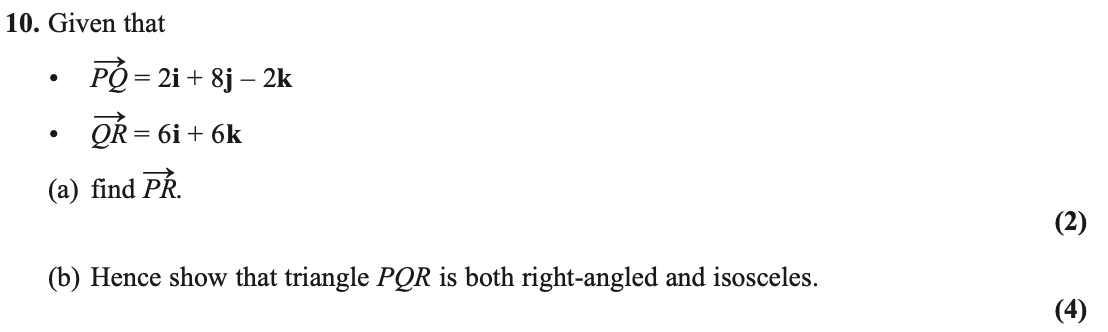
Given that vector PQ = 2i + 8j - 2k and vector QR = 6i + 6k, (a) find vector PR. (2) (b) Hence show that triangle PQR is both right-angled and isosceles. (4)